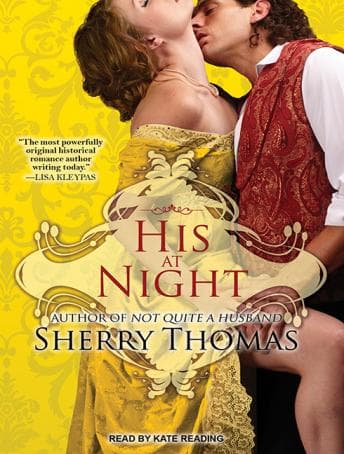

Sherry Thomas wrote a spy novel disguised as a romance, and I almost missed it.
I was grading sophomore essays on The Great Gatsby — it was maybe 11:30 PM, Denise had already gone to bed, and I had seventeen papers left that all started with "In the novel The Great Gatsby by F. Scott Fitzgerald..." So I put in my earbuds, fired up His at Night, and figured I'd get through a few chapters of pleasant historical romance while marking up thesis statements. By hour two, I'd stopped grading entirely. The red pen was just sitting there on the kitchen table, cap off, drying out. I didn't care.
Two Men Living in One Voice
Here's what caught me off guard: Lord Vere is essentially performing a role within a role. He's a secret government agent pretending to be the biggest idiot in London high society — think bumbling aristocrat, the kind of man who'd trip over his own walking stick at a ball. And Kate Reading does something genuinely clever with this. She doesn't give Vere two wildly different voices. Instead, his "fool" persona and his real self share the same vocal foundation, but the fool version has this slightly looser cadence, a touch more air in the delivery, vowels that drift just a beat too long. It's subtle. The kind of thing you'd miss at 1.5x speed. (My students would absolutely miss it. They'd have it at 2x and wonder why they didn't understand the plot.)
The real Vere — the sharp, angry, controlled man underneath — comes through in tighter consonants and a colder rhythm. Reading doesn't announce the shift. She just does it, and your ear picks up the tension before your brain catches up. This reminds me of what Hemingway said about the iceberg theory — most of the meaning lives beneath the surface. Reading trusts the listener to feel the difference rather than spelling it out.
Elissande's Trap Is the Real Story
Let's talk about what Thomas is really saying here, because the romance is almost a Trojan horse for something darker. Elissande Edgerton is a woman living under the thumb of a genuinely awful uncle — not cartoonish-villain awful, but the grinding, daily kind of control that makes you forget what freedom even looks like. She engineers her own marriage to Vere as an escape route. Not for love. For survival.
And Thomas doesn't let that be simple. Once Elissande gets what she wanted — marriage, distance from her uncle — she has to reckon with the fact that she manipulated a man who was also manipulating everyone around him. Two people wearing masks, stuck in a house together, slowly realizing neither of them is who they claimed to be. I kept thinking about the psychological chess match in Deal with the Devil, where two people with competing agendas are also, stubbornly, falling for each other — though Thomas writes the deception with considerably more teeth. The scenes where Vere drops the fool act and his real anger surfaces — anger at being trapped, at being seen — are genuinely uncomfortable. Reading's delivery in those moments goes quiet and precise, which hits harder than shouting would have.
There's a particular stretch in the middle where Vere and Elissande are circling each other with competing agendas, and Thomas writes their dialogue like a chess match where both players are pretending they don't know how to play. The prose deserves to be savored in those sections. Thomas chose every word with surgical care — English is her second language, which I find staggering given how precisely she wields it.
Where the Seams Show
I won't pretend it's flawless. The pacing sags in the back third when the external plot — the uncle's dark secrets, the spy business — has to resolve alongside the romance. Thomas is stronger with internal conflict than external mechanics, and you can feel the machinery grinding when she has to tie up the thriller elements. A couple of the emotional reconciliation scenes between Vere and Elissande moved faster than I wanted them to. After spending hours watching these two circle each other with such care, the resolution felt slightly rushed. I wanted one more conversation. One more silence.
And while Reading's performance is smart and controlled, I noticed moments — particularly in some of the more heated romantic scenes — where I wanted a little more abandon in her delivery. She stays measured when the text is begging for someone to lose composure. It's a minor thing, but I felt it.
Who This Is Really For
If you come to historical romance for wallpaper Regency fluff, this will blindside you. In a good way, probably, but fair warning. If you loved Jane Eyre or North and South — stories where the romance is tangled up in power dynamics, class, and the question of whether two damaged people can actually be honest with each other — this is their spiritual successor in genre fiction form. My students would hate this. I love it.
Worth pausing the faculty meeting for. Worth letting the red pen dry out.
That RITA Award wasn't a fluke. Thomas earned it with every uncomfortable, electric page.