
"Seek clarity, generate energy, raise necessity, increase productivity, develop influence, demonstrate courage."
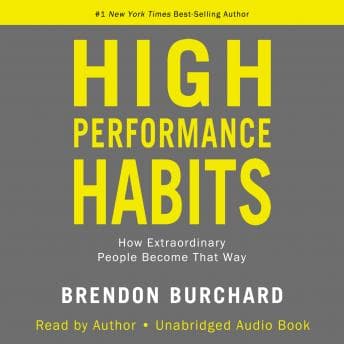
I was halfway through chopping onions for a chana masala — eyes already watering, hands smelling like cumin — when Brendon Burchard laid out his six habits framework somewhere around hour two. And I stopped chopping. Because my brain did the thing it does when it spots a pattern: it started running his model against every psychological framework I've studied.
Here's what I found myself asking: why does this book work on some people like a revelation and bounce off others like a rubber ball?
The Psychology Behind the Six Habits (And What Burchard Gets Right)
I'll give Burchard credit where it's due. The research actually shows — and I mean genuinely peer-reviewed research, not just the "we surveyed our coaching clients" variety — that habits like seeking clarity and raising necessity overlap significantly with self-determination theory. Deci and Ryan would recognize the bones of this framework. The emphasis on clarity maps onto autonomy, the social influence habit connects to relatedness, and the productivity habits touch competence. Whether Burchard intended that parallel or stumbled into it, the structure has real psychological scaffolding.
What makes his approach compelling is the specificity. He doesn't just say "be productive" — he breaks it down into what he calls "Prolific Quality Output" and identifying the five major moves that matter most in your field. That's concrete. That's actionable. My research-brain appreciated the attempt to ground everything in his "High Performance Indicator" assessment data, even if I have methodological questions about the sample and self-selection bias. (The researcher in me never fully turns off. Sorry not sorry.)
The six habits themselves — clarity, energy, necessity, productivity, influence, courage — aren't individually groundbreaking. You've seen versions of them in Covey, in Duckworth, in Dweck. But Burchard's contribution is the architecture: the argument that these six, practiced together and deliberately, create compound effects. That's a legitimate hypothesis, and he builds a case for it over ten and a half hours.
The Ego Problem (Let's Talk About It)
Okay. So. The elephant.
Burchard narrates his own book, and he narrates his own life quite a bit while he's at it. There's a recurring pattern — personal anecdote about coaching a CEO, or surviving a car accident that changed his perspective, or mentoring someone extraordinary — and after a while you start to notice that Brendon Burchard is the protagonist of every story in a book that's supposed to be about you.
The protagonist exhibits classic self-referential authority building. Which — look, I get it. He's a performance coach. His credibility IS the product. But psychologically, this doesn't track as well as he thinks it does. When a narrator keeps positioning himself as the expert who has cracked the code, it activates skepticism in anyone with even mild critical thinking skills. Some listeners will find his passion authentic and energizing. Others will feel like they're sitting through a very long, very polished TED Talk where the speaker forgot to stop talking about himself.
His voice is genuinely passionate. Clear delivery, good pacing, no stumbling. But the performance has a "motivational seminar" quality — high energy, lots of emphasis, building to crescendos — that over ten-plus hours can feel exhausting rather than inspiring. My therapist would have thoughts about why I found his relentless positivity slightly suspicious. (I found it slightly suspicious.)
What the Framework Misses
This is a fascinating case study in what happens when coaching wisdom meets academic ambition. Burchard wants this to be science-backed. He references studies, he cites data, he talks about his large-scale surveys. But the psychological depth is surface-level. There's almost no discussion of why people fail to adopt these habits — the role of trauma, socioeconomic barriers, neurodivergence, cultural context. The model assumes a relatively privileged baseline: you have the time, energy, and resources to "generate energy" through better sleep and exercise. Cool. What about the single parent working two jobs?
The book also conflates correlation with causation pretty liberally. High performers demonstrate these habits. But do the habits cause high performance, or do people who are already succeeding have the bandwidth to practice them? That same correlation-as-causation sleight of hand shows up in Why We Get Fat: And What to Do About It — another book where the author's confidence in his framework outpaces the methodological rigor underneath it. Burchard doesn't wrestle with that question, and I wish he had.
Who Gets Value Here (And Who Should Save Their Credit)
If you're in a transition period — new role, new goals, feeling stuck — and you want a structured framework to organize your efforts, this delivers. The exercises are practical. The habits are clear and memorable. At 1.25x speed, it's a solid week of commute listening.
But if you've already read Atomic Habits, The 7 Habits, and Deep Work, you'll recognize most of these ideas wearing different clothes. And if self-help authors who use their own success stories as primary evidence make you twitchy, budget your patience accordingly.
My Clinical Assessment
Burchard built a functional framework on legitimate psychological principles, then buried it under too much personal branding. Strip away the coaching-guru energy and there's a genuinely useful organizational system for intentional living. I just wish it trusted me — the listener — enough to let the ideas speak without the constant reminder of who figured them out.