I was shelving returns in the horror section last Tuesday — the branch was empty, rain hammering the windows, Oregon doing its whole gothic thing — when I realized I'd been standing motionless between the stacks for a solid five minutes, one earbud in, completely frozen by a scene where a killer is watching from the treeline. Just standing in the woods. Watching. That's it. And Daniela Acitelli's voice dropped into this low, almost intimate register for the killer's internal monologue that made my skin crawl so hard I actually looked over my shoulder. In a library. In broad daylight. Well. Broad gray-light. It's Oregon.
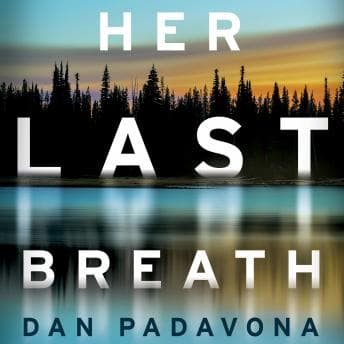
Her Last Breath is the first book in Dan Padavona's Wolf Lake series, and it's doing something I appreciate more than I can say: it's a small-town thriller that actually earns the small town. Detective Thomas Shepherd isn't some big-city hotshot who condescends to the locals. He's broken. Shot in the line of duty, retreating to Wolf Lake to stitch himself back together. And then a body washes up on his shore — literally his shore — and the whole town decides a teenage boy with a violent past did it. Padavona builds the pressure from both directions: the community closing ranks around their convenient suspect, and Shepherd pulling at threads that nobody wants pulled.
The Lakeside Isn't Safe (And Neither Is Your Commute)
What works here is the dread architecture. Padavona understands that the scariest thing isn't the murder — it's the aftermath. The way a community can decide someone is guilty because it's easier than being afraid. The way Shepherd keeps digging even when the evidence against the kid looks damning. There's a particular stretch around the midpoint where Shepherd visits the boy and you can feel this kid's terror — not of the killer, but of the system about to swallow him whole. That hit different for me. Growing up in a household where you were always one wrong move from judgment, I recognize that specific flavor of helplessness.
The pacing is smart. At just under eight hours, it doesn't overstay. Padavona front-loads atmosphere — the lake, the woods, the way isolation can feel like freedom until it becomes a cage — and then tightens the screws steadily. There's no saggy middle act where everyone sits around theorizing. Shepherd moves, investigates, makes enemies. The killer lurks. And I mean lurks. Those woods scenes are the real horror of the book. Padavona writes the forest around Wolf Lake like it's another character, something ancient and indifferent that doesn't care whether you live or die.
Acitelli Understands the Assignment
The narrator commits. That's rare. Daniela Acitelli has this smoky, almost velvety quality that works beautifully for the baseline narration — it gives the whole thing a noir-adjacent feel without tipping into pastiche. But where she really earns it is character separation. Shepherd sounds weary, measured, a man trying to be precise because precision is the only thing holding him together. The killer? Acitelli drops into something quieter and more controlled for those sections, which is so much more unsettling than going big and theatrical. The restrained menace is what got me standing frozen in the 800s section like an idiot.
She also handles the emotional scenes — and there are more than you'd expect from a thriller — with genuine weight. Shepherd's grief, his guilt about returning to Wolf Lake as a diminished version of himself, the complicated relationship with the community that both needs and resents him. Acitelli plays all of it straight, no melodrama. Classically trained, apparently, and you can tell. She trusts the text.
My one note — and it's minor — is that a couple of the secondary townspeople blend together vocally. In a small-town story with a decent cast, I occasionally had to recalibrate who was speaking. Not a dealbreaker, but in a genre where "who said what" can be life or death for tension, it's worth mentioning.
Who Needs This (And Who Should Probably Pass)
If you're looking for gore or shock value, this isn't your book. Padavona writes psychological dread, not splatter. Shirley Jackson walked so authors like this could run — the horror is social, systemic, rooted in what people do to each other when they're scared. That same vein of community-as-threat runs through All That Remains, which I covered a while back and kept thinking about during Shepherd's more isolated moments. If you loved the small-town paranoia of something like Broadchurch or Sharp Objects, this scratches that itch.
Skip if you need a breakneck pace from page one. This builds. It rewards patience. And honestly? It rewards darkness. I listened to the last two hours at home, lights off, Shirley (my cat) curled up on the couch being characteristically unimpressed while I was genuinely tense about whether Shepherd was going to make it.
My podcast listeners are going to love this. Series opener that actually closes its central case while leaving enough threads dangling to pull you forward. Finally, horror-adjacent thriller that respects the genre enough to let the quiet moments be quiet — and the terrifying moments be absolutely, skin-crawlingly terrifying.
Shelving This One Face-Out
Solid first entry in a series I'm now committed to. The audiobook format serves it well — Acitelli's performance adds a layer of atmospheric tension that I suspect reading silently wouldn't quite replicate. I listened in the dark. Mistake? Maybe. Worth it? Absolutely.