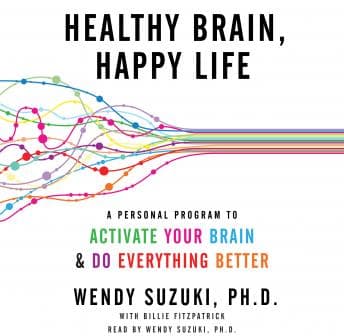

"I was overweight, lonely, and tired." Somewhere around minute 40, Wendy Suzuki says this with such flat honesty that I actually looked up from my phone on the Caltrain. Not because it was dramatic - because it wasn't. It was the voice of someone who'd been optimizing one variable (career) while letting every other system degrade. As someone who's debugged production systems at 2AM while eating cold pizza and wondering when I last saw sunlight, yeah. That hit.
The Bug Report That Sparked a Rewrite
Here's the setup: Suzuki is a tenured NYU neuroscientist, world-class memory researcher, and she realizes on a rafting trip for her birthday that she can barely keep up physically. She's built this incredible career studying the hippocampus and memory formation, but she's basically been running her own hardware into the ground. So she starts going to exercise classes. And then - because she's a neuroscientist and can't help herself - she starts studying why exercise is making her brain work better.
The core thesis is pretty simple: aerobic exercise triggers neurogenesis in the hippocampus, improves prefrontal cortex function, and basically upgrades your cognitive hardware. If you've read anything about exercise and brain health in the last decade, this won't blow your mind. But Suzuki's angle is different because she's not just citing studies - she literally ran some of them. She redesigned her NYU course to include exercise and measured the cognitive outcomes. That's not a pop-science writer summarizing PubMed; that's someone showing you their own data.
The 4-minute Brain Hacks scattered throughout are... fine. They're basically micro-exercises and mindfulness prompts. Think of them as utility functions you can call anywhere. Not revolutionary, but practical. The ROI on this audiobook is mostly in the framework, not the hacks themselves.
Where the Merge Conflicts Show Up
Okay, here's my honest take: this book has a pacing problem. The first 60 minutes are basically an extended forward and personal backstory before Suzuki gets into any real science. I get why - she's building the narrative arc, showing you the "before" so the "after" lands harder. But when you're on a 6AM train and you're waiting for the neuroscience to kick in, it feels like watching a loading bar.
And the personal diary sections? They keep coming back. Her dating life, her creative pursuits, her journey to becoming an exercise-class-teaching professor. Some of it's genuinely interesting - the bit about how she started teaching an exercise class called "intenSati" at NYU and basically turned her neuroscience lectures into participatory experiences is pretty cool. But other stretches feel like someone's memoir got tangled up with a science book and neither editor won the argument.
The science, when it arrives, actually holds up. Suzuki knows her BDNF from her cortisol, and she explains neuroplasticity mechanisms clearly without dumbing it down to nothing. She talks about specific brain regions - dentate gyrus, prefrontal cortex - and what exercise does to them at a cellular level. It's not Huberman-podcast-level depth, but it's solid and well-sourced. This is basically Spark by John Ratey but with a personal memoir woven through it. The mental performance angle also reminded me of Mindful Athlete, which approaches the brain-body connection from the other direction - starting with elite athletic performance and working back toward the neuroscience of focus.
Author-Narrated: The Double-Edged Sword
Suzuki narrates her own book, and she sounds exactly like what she is - an enthusiastic professor giving a lecture she genuinely cares about. Her energy is real. You can hear the excitement when she talks about her research findings. But she's not a professional narrator (she's not Ray Porter, that's for sure), and sometimes the pacing feels like she's reading rather than performing. It's competent, warm, occasionally a little flat during the science-heavy sections.
I bumped this to 1.5x and it was perfect. At default speed, the diary sections dragged. At 1.5x, the whole thing tightened up and I finished it in about four commutes.
Who This Is Actually For (and Who Should Skip)
Perfect for: You're a knowledge worker who knows exercise is good for your brain but wants the actual neuroscience behind WHY, delivered by someone who lived the transformation and studied it in her lab. You're okay with memoir mixed into your science. You want something motivating but not bro-science.
Skip for: You've already read Ratey's Spark, Huberman's content, or Suzuki's TED talk (which covers like 40% of this book in 12 minutes). Or if personal narrative sections make you impatient - there's a lot of them.
Commit Message: Solid Science, Needs Refactoring
TL;DR: Worth your commute if you haven't gone deep on exercise neuroscience before. Suzuki's credibility is the differentiator here - she's not just reporting on the research, she IS the research. But the book could've been 30% shorter without losing substance. The memoir-to-science ratio skews more personal than I wanted, and it takes too long to boot up. Still, by the end I was genuinely motivated to not skip my morning workout, and I understood exactly why my post-exercise code reviews are sharper. That's worth something.
Could've been a blog post? No - but it could've been a tighter book.