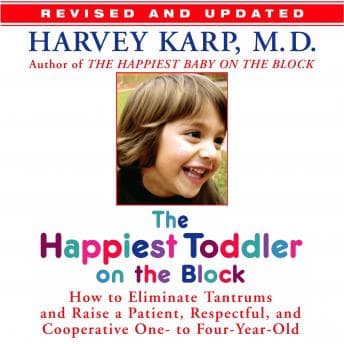

Does a book about toddlers belong in a business consultant's Audible library? Look, when my buddy Kevin became a dad last year and started showing up to our golf games looking like he'd survived a hostile takeover, I figured I should do some research. You know, in case Jenny and I ever decide to complicate our lives in that particular way.
Bottom Line: Dr. Karp's core framework is solid—maybe 2 hours of genuinely useful content stretched across 7 hours. Classic business book problem, just applied to tiny humans who scream in grocery stores.
The Framework That Actually Works
Here's what my parents did instinctively. Now it has a TED talk.
Karp's big insight is that toddlers are basically little cavemen—their brains haven't developed the wiring for rational conversation yet. So when your kid is melting down because you gave them the blue cup instead of the red cup, you can't logic your way out of it. You have to speak their language first. He calls it "Toddler-ese" which sounds ridiculous but—and I hate admitting this—the examples actually make sense.
The "Fast-Food Rule" is pure operational efficiency. Just like a drive-thru worker repeats your order back before giving you what you want, you reflect the kid's feelings before redirecting. It's stakeholder management for people under three feet tall. I've seen this principle fail at companies that skip the acknowledgment step and jump straight to solutions. Turns out it fails with toddlers too.
The green light/yellow light/red light system for categorizing behaviors? That's just a decision matrix. Green behaviors you encourage, yellow you ignore, red you stop immediately. Simple prioritization. The core concept is worth the listen. The other 5 hours? Not so much.
Tim Fannon Gets the Job Done
Fannon's narration is... fine. Competent. He's got that clear, neutral delivery that works for instructional content. Not going to win any awards, but he doesn't get in the way either. I will say there were stretches where his voice got a bit flat—I was listening during a client flight to Phoenix and definitely zoned out during some of the more repetitive sections. My 2.0x speed couldn't save those parts.
The production quality is clean, no complaints there. But there's zero bonus content, which feels like a missed opportunity. A quick-reference summary chapter at the end would've been helpful for the parents who are, you know, sleep-deprived and can't remember what they listened to yesterday.
Where It Falls Short
Here's my issue. Karp leans heavy on the behavioral modification stuff—rewards, consequences, the whole system. And that's practical, sure. But some of the criticism I've seen about the book lacking emotional intelligence depth? I get it. This is very much a "here's how to get compliance" playbook rather than a "here's how to raise an emotionally intelligent human" guide.
Also—and Jenny would say I'm being harsh, Jenny is right—some of this advice feels pretty one-size-fits-all. Every kid is different. Every family situation is different. Karp acknowledges this but then kind of... doesn't really address it? It's like a consulting framework that works great in the case study but needs serious customization for real implementation.
For the deeper developmental psychology stuff, grab "The Whole-Brain Child" by Siegel and Bryson as a companion. That one goes more into the why behind kid behavior. And if you're looking for frameworks that actually change behavior—adult behavior—Think and Grow Rich has that same "here's the system, now execute" energy. Together they're a decent toolkit.
Who Should Listen (And Who Should Skip)
First-time parents who need a quick operational framework before they're in the trenches—skip to the chapters on Toddler-ese and the traffic light system. Thank me later. If you've already got kids and have figured out your own methods? Probably not worth the 7 hours. Skim the summary online.
I sent Kevin the audiobook link. He texted back three days later saying the Fast-Food Rule actually worked during a restaurant meltdown. So there's that. One data point in favor.
Would I listen again? No. But I might actually reference this if I ever need it. And honestly, for a parenting book, that's a win.