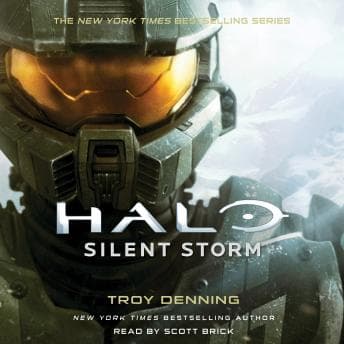

Look, I need to rant about something before we get into this. Scott Brick. Scott Brick, Scott Brick, Scott Brick. I've listened to dozens of his narrations across sci-fi and thriller, and every single time I come away thinking "this man is technically excellent and yet somehow makes me want to argue with my earbuds." So when I fired up Halo: Silent Storm during a late-night board game solo session (yes, I solo board games, no I will not apologize), I knew what I was getting into. And honestly? This time it mostly worked. Mostly.
But let's talk about the actual book first, because Troy Denning did something here that genuinely surprised me.
Master Chief at Level 1 Is More Interesting Than Master Chief at Level 20
This is set in 2526 - barely a year into the Human-Covenant War. John-117 and his Spartans are young. Like, terrifyingly young supersoldiers who are still figuring out that the aliens they're fighting aren't just another insurgent faction. The UNSC knows almost nothing about the Covenant, and that uncertainty drives the whole book. It's a military black ops counterattack mission where humanity is punching up against superior tech, and the Spartans are basically the only card left to play.
What got me was the progression. (The progression is satisfying.) You watch John go from "enhanced child soldier following orders" to "tactical leader making calls that admirals don't agree with," and Denning earns every step of that arc. There's a subplot involving human insurrectionists who've decided allying with the Covenant is their best shot at independence from Earth's government, and they've planted a sleeper agent to sabotage the Spartan mission. That political layer - humans betraying humans while aliens are literally trying to genocide the species - gave me serious Battlestar Galactica vibes. My D&D group would love this kind of faction intrigue.
Denning's background as a game designer shows. The space combat sequences have this almost tactical wargame quality - you can feel the positioning, the resource management, the "we have three options and they're all bad" decision trees. If you don't like info-dumps, this isn't for you (but you're wrong). Kevin Hearne pulls off something similar in Tricked, where the mythology infrastructure threatens to swamp the plot but you're weirdly grateful for every footnote anyway. The technical details about Spartan EVA operations and ship-to-ship engagement felt like someone actually thought through the physics and logistics instead of just writing "and then there was a cool space battle."
The Scott Brick Question
Okay, so here's where it gets complicated. Brick has this Shakespearean theater energy - every line gets delivered with weight and intention. For the military briefing scenes and internal monologue? That actually works. He gives John-117 this controlled, almost clinical delivery that fits a kid raised to be a weapon. The man knows how to pace a tense tactical sequence.
But - and this is where the fanbase splits hard - he's not Steve Downes. If you grew up hearing Downes as Master Chief in the games, Brick's interpretation is going to feel wrong in your bones. It's like hearing someone else do Logen Ninefingers after Steven Pacey. (Steven Pacey walked so other narrators could run, and some of them tripped.) Brick's Chief is more cerebral, less iconic growl. I adjusted after a couple hours, but I can see why some listeners bounced off entirely.
The pacing issues people complain about are real, though. There are stretches in the middle third where the political maneuvering slows to a crawl, and Brick doesn't shift his energy enough to differentiate. When you're cutting between Spartan action sequences and insurrectionist scheming, the narrator needs to signal that tonal shift, and Brick just... maintains the same register. I bumped to 1.25x for those sections and it helped a lot.
Who's Rolling Initiative on This One
If you're a Halo lore junkie who wants early-war Master Chief content with actual military sci-fi bones - not just franchise filler - this delivers. It's Denning doing what Denning does best: taking an established universe and writing something that feels like it belongs on the shelf next to standalone mil-SF. Scribe Award finalist for a reason.
If you need your Master Chief to sound like the games, or if mil-SF tactical detail makes your eyes glaze over, maybe try the ebook instead. The audiobook is good, not great, carried more by the source material than the performance.
I read this instead of writing my thesis. Dr. Patel, if you're reading audiobook reviews at midnight instead of grading my proposal draft, we have bigger problems than my timeline.
Roll for Damage, Not Persuasion
This is Sanderson-level world-building applied to a franchise that usually gets competent-but-forgettable tie-in novels. Denning clearly cares about the Halo universe in a way that elevates the whole thing. The Brick narration is a speed bump, not a roadblock. At 11 and a half hours, it's a solid weekend listen - just keep that 1.25x ready for the political chapters.