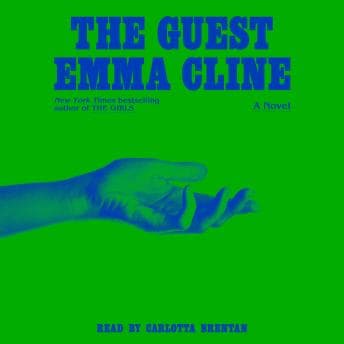

I was shelving returns on a rainy Tuesday evening — the kind of Pacific Northwest evening where the library empties by 6 PM and the fluorescent lights start humming a little too loud — when I decided to pop in my earbuds and let Carlotta Brentan's voice carry me through the last few hours of The Guest. And look, I need to talk about this book, because it did something to me that horror rarely does: it made me deeply, physically uncomfortable without a single monster in sight.
Emma Cline wrote The Girls, which I respected more than loved. So I came to The Guest with measured expectations. What I got was something closer to Patricia Highsmith than anything in Cline's previous work — a sustained, almost suffocating exercise in social horror that understands dread better than half the books shelved in my library's horror section.
The Con Artist as Final Girl
Alex is... a problem. Not in the way publishers mean when they slap "unlikable female protagonist" on marketing copy. She's a problem the way a crack in a dam is a problem — quiet, widening, inevitable. She gets dumped by the older man she's been staying with on the East End of Long Island, and instead of taking the train back to the city like a normal person, she just... stays. Drifts. Grafts herself onto other people's summer like a parasite in a sundress.
What Cline does with this premise is strip away every safety net — Alex's phone is waterlogged, her resources are basically nonexistent, and her only currency is the ability to read people's desires and reflect them back. It's grifter fiction, sure, but it's also survival horror. The Hamptons as hostile environment. The brunch table as killing floor. Enemy of Mine works a similar angle — the predator-as-protagonist framework where you're never quite sure if you're rooting for someone or just watching them survive.
The dread here isn't about what's chasing Alex. It's about what happens when the performance slips. Every interaction is a tightrope walk, and Cline writes them with a scalpel precision that had me holding my breath while literally scanning library barcodes. There's a particular stretch where Alex is at a party she absolutely should not be at, adjusting her body language and vocal register in real time, and I could feel the flop sweat through my earbuds. This understands that horror isn't about gore — it's about dread.
Brentan's Flat Affect Is the Whole Point
Here's where it gets interesting. Carlotta Brentan narrates Alex with this flat, breathy delivery — almost drugged, almost bored — and your first instinct might be to think she's phoning it in. She's not. She's doing something much smarter than that.
Alex is performing indifference as armor. She can't afford to care, or to show that she cares, because caring means vulnerability and vulnerability means getting caught. Brentan gets this. Her Alex sounds like someone who has carefully sanded down every emotional edge, and when she shifts to secondary characters — a slightly brighter register for the oblivious rich women, a particular flatness for the men who want things from Alex — you can hear the calculation underneath.
The narrator commits. That's rare.
Now. The complaints about her male-female voice differentiation? I get it. There are moments where the tonal shift between a male and female character in the same scene gets a little distracting, like your brain has to recalibrate who's talking. It's not dealbreaking, but at maybe three or four points I had to rewind a few seconds to sort out the dialogue. Minor friction in an otherwise smartly calibrated performance.
The Ending Will Make You Want to Throw Your Phone
I have to be honest about this because my podcast listeners would never forgive me otherwise: the ending is going to divide people. Hard. Cline doesn't give you resolution so much as she gives you an exhale — or maybe the absence of one. It's ambiguous in a way that feels deliberate rather than lazy, but I completely understand the readers who feel cheated.
Personally? I think it's the only ending this book could have. Alex isn't a character who gets closure. She's a character who gets the next moment, and the next, and the next, until eventually the moments run out. The lack of catharsis IS the horror. But if you need your stories to land somewhere concrete, fair warning.
At 8 hours and 36 minutes, the length is right. It's a week-long timeline compressed into a listen you can knock out in two focused sessions. The pacing is deliberate — slow but not sluggish. Think of it as water rising around your ankles so gradually you don't notice until it's at your chest.
Who Gets an Invitation and Who Gets the Train
If you loved Eileen by Ottessa Moshfegh or the cold precision of early Bret Easton Ellis, this is your next listen. If you want plot-heavy thriller mechanics with twists and reveals, you'll be frustrated. This is character study as pressure cooker.
Shirley (my cat) was unimpressed. I was terrified. Not by anything supernatural — by how easily a person can become invisible, and how dangerous invisible people can be.
Shirley Jackson walked so Emma Cline could run. Different terrain, same understanding: the real horror is always social.