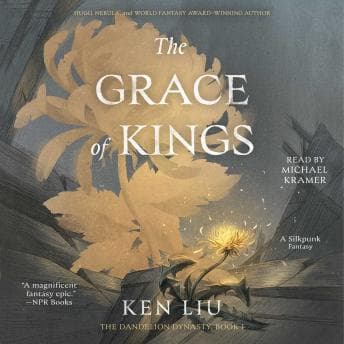

Twenty-one hours. Twenty-one hours of silk-draped airships, shapeshifting gods, and two men whose friendship was always destined to become a war. I started this during a particularly brutal stack of sophomore essays on The Great Gatsby - you know, the ones where every student discovers symbolism for the first time and thinks they invented literary analysis - and by hour fifteen, I'd forgotten what green lights even meant.
Let me complain about something first, because I need to get this off my chest: Ken Liu wrote a book that demands your full attention while also being twenty-one hours long. This is not a casual relationship. This is a commitment. This is moving in together after the third date. And the middle section? Look, I've taught Moby Dick. I've defended the whaling chapters to skeptical juniors for two decades. But even I found myself drifting during some of the war descriptions here, mentally composing grocery lists while armies clashed.
But here's the thing - and this is why we still read the classics, even when they test our patience - Liu is doing something genuinely ambitious.
What Hemingway Would've Called "The Real Thing"
This isn't just fantasy wearing Chinese historical robes. Liu is working in the tradition of the epic, the genuine article - think Romance of the Three Kingdoms filtered through a sensibility that understands both Western narrative structure and Eastern philosophical complexity. Kuni Garu, the charming bandit who talks his way into power, and Mata Zyndu, the noble warrior who can't understand why honor isn't enough - they're archetypes, sure. But Liu lets them breathe. Lets them contradict themselves. Lets them make choices that feel inevitable and tragic simultaneously.
The prose deserves to be savored. Liu writes sentences that my students would hate - long, winding things with clauses that build like waves - and I love it. He trusts the reader to keep up, to remember details from three hours ago, to understand that the gods watching from above aren't just decoration but commentary on human ambition.
Michael Kramer Knows What He's Doing
I've listened to Kramer narrate Sanderson. I've listened to him carry the Wheel of Time for what felt like my entire thirties. The man understands epic fantasy the way a jazz musician understands standards - he knows when to let the prose breathe and when to push. His Kuni has this warm, slightly roguish quality that makes you understand why people follow him. His Mata carries aristocratic weight, a voice that's never known doubt until suddenly, devastatingly, it does.
What impressed me most: Kramer handles Liu's info dumps with a matter-of-fact delivery that somehow makes worldbuilding exposition feel like campfire storytelling rather than a textbook. There's a personal investment in his performance - you can hear him leaning into the emotional beats, making moments that could feel distant feel surprisingly intimate.
That said - and I'm being honest here - the pacing struggles are real. Some listeners report Kramer couldn't save the middle section, and I understand that complaint. When the narrative slows for extended military strategy, even excellent narration can't manufacture urgency that isn't on the page.
Pause Is Punctuation
This reminds me of what I tell my students about Shakespeare: the language sounds strange until it doesn't. Liu's style - influenced by classical Chinese narrative traditions - uses repetition and formal structures that feel odd to Western ears at first. Kramer navigates this beautifully. He doesn't fight the rhythm; he rides it.
I listened at 1.0x because the author chose those words. Some of you will speed it up - I get it, you have lives - but you'll lose something. The cadence matters here.
Who Should Clear Their Schedule (And Who Shouldn't)
If you loved Shogun's patient worldbuilding, this is its spiritual successor with gods and airships. If you're willing to invest - really invest - in watching two friends become enemies, in understanding why good people build terrible systems, in sitting with moral complexity that doesn't resolve neatly? This is your book. That same wrestling with power and morality shows up in Beyond Good and Evil, though Nietzsche skips the airships.
Skip it if you need constant action or you're the kind of reader who bails on "boring" chapters. The middle will test you.
Fair warning: the content here gets dark. Child death, graphic violence, torture - Liu doesn't flinch from the costs of empire-building. My students would hate this. I love it.
Worth the Investment (With Caveats)
Is it perfect? No. The middle sags. Some characters feel like chess pieces rather than people. But when it works - and it works more often than not - Grace of Kings achieves something rare: it makes you feel the weight of history being made, the tragedy of men who could have been brothers choosing to be rivals instead. Kramer's performance carries you through the slower stretches, and the payoff is genuine.
Denise asked me last week why I was so quiet on our lakefront walk. I told her I was thinking about the nature of legitimate power and whether justice can exist without mercy. She reminded me to pick up milk.
This is that kind of book.