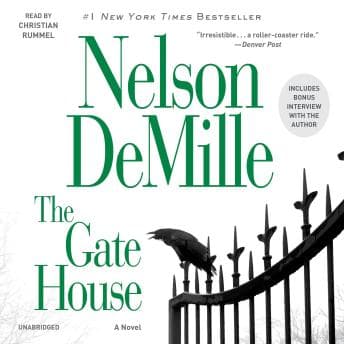

I was up past midnight last Tuesday, sitting on the back porch with Ranger at my feet and a bourbon I'd forgotten about going warm on the armrest. Couldn't stop listening. Twenty-one hours is a serious commitment — that's longer than most deployments feel when you're actually in the thick of it — but Nelson DeMille had me pinned down from about hour two and I never seriously considered retreating.
A Wall Street Lawyer Walks Into a Mob Boss's Living Room
Let me cut to the chase: The Gold Coast is not a thriller in the way most people mean when they say thriller. Things don't explode. Nobody gets extracted from a hostile compound. What DeMille does instead is something sneakier — he puts you inside the head of John Sutter, this old-money WASP lawyer on Long Island's North Shore, and then drops a Mafia don named Frank Bellarosa right next door. And you watch the slow, inevitable collision between these two worlds like watching a convoy roll toward an IED you can't call out.
Sutter's voice is the engine here. The guy is sardonic, self-aware, funny as hell, and deeply in denial about the rot in his own life. He'll spend three minutes riffing on the absurdity of his country club's dress code and then drop something about his marriage that hits like a gut punch. DeMille wrote him with the kind of precision I associate with the best intelligence briefings — every detail matters, even when it seems like he's just rambling about old money and yacht clubs.
Bellarosa, the don, is the opposite of every cartoon mobster you've seen on screen. He's shrewd, almost charming, and DeMille gives him this genuine curiosity about the WASP world he's invaded. The scenes where Bellarosa and Sutter are just... talking — dinner at the don's estate, touring the property, negotiating unspoken power dynamics — those are better than most firefights I've read in action novels. I've seen this scenario play out in real life, by the way. Not with the Mafia, but the dynamic of someone powerful and dangerous befriending someone who thinks they're too smart to get played? That's universal. I picked up on that same uneasy dance of power and manipulation in Born in Death, where the tension runs beneath every polite conversation.
Susan Sutter Is the Real Weapon in This Book
Here's where it gets uncomfortable, and where DeMille earns real respect. Susan Sutter — John's wife — starts out looking like a standard-issue beautiful rich woman. Horses, charity events, old family name. But as the book progresses, she becomes the most dangerous variable in the equation. Her pull toward Bellarosa isn't just an affair — it's a demolition charge placed at the foundation of everything Sutter thinks he understands about his life.
The final fourth of this book goes dark. Genuinely dark. I won't spoil it, but the shift from DeMille's breezy social satire into something raw and almost violent caught me off guard, and I'm not easy to catch off guard. Linda walked out onto the porch around 12:30 and asked if I was okay. I told her the book got heavy. She gave me that look — the one that says she knows I'm not talking about the weight of my phone.
Rummel Does the Heavy Lifting
Christian Rummel narrates this, and the man earns his paycheck. Twenty-one hours of first-person sardonic narration is a marathon, and Rummel nails Sutter's dry, self-deprecating tone without ever making it feel like a performance. His Bellarosa has this subtle warmth layered over something harder underneath — you can hear why Sutter would let his guard down around the guy. His Susan shifts over the course of the book from clipped and controlled to something looser and more reckless, which tracks perfectly with her character arc.
I know some listeners wanted Scott Brick on this one, and I get it — Brick's a known quantity for DeMille. But Rummel won an AudioFile Earphones Award for this performance and it's deserved. At 1.25x speed, he holds up perfectly. No loss of his comic timing, no muddled character transitions.
Who's This For (And Who Should Stand Down)
If you need a body count by chapter three, this isn't your mission. This is a slow burn — a long, smart, character-driven book about class, power, sex, and the lies rich people tell themselves. Think of it as The Great Gatsby if Gatsby was a mob boss and Nick Carraway was funnier and more self-destructive.
If you appreciate DeMille's other work — the social observation, the wit, the way he builds tension through conversation rather than just action — this might be his best. It's certainly his most personal-feeling.
Skip it if bad language or sexual content bothers you. Also skip it if you want something you can half-listen to while doing expense reports. This one demands focus.
Mission Debrief
Worth your time? Here's the debrief: Twenty-one hours is a lot to ask. DeMille earns every minute. The author clearly did his homework on both the old-money Long Island world and the mechanics of organized crime, and neither side feels fake. Rummel's narration elevates material that was already strong. And that ending — I'm still turning it over in my head days later.
Ranger approved this one. He didn't even get up when things got tense in the last quarter, which is his version of a five-star review.