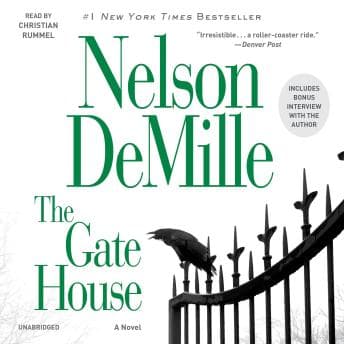

"I'm back." Somewhere around hour two, John Sutter says this — not with triumph, not with dread, but with that particular flavor of self-aware resignation that only a WASP who's been running from his own life for a decade can manage. And I thought: yeah, buddy. You and me both. Because I'd come back to this world too, having listened to The Gold Coast years ago, and now here I was, stirring dal at midnight with Christian Rummel's voice filling my kitchen, wondering why I was voluntarily spending 22 hours with a man whose psychological defense mechanisms could fill a DSM chapter.
John Sutter Is His Own Worst Case Study
Here's what makes John Sutter fascinating and infuriating in equal measure: he is a man who narrates his own life with clinical detachment while making the most emotionally unhinged decisions imaginable. DeMille writes him as someone who uses wit and class consciousness as armor — the constant sardonic commentary about Gold Coast money, the old families, the crumbling estates — and it works. Psychologically, this tracks. Sutter is classic intellectualization as defense mechanism. He can tell you exactly what's wrong with going back to Susan. He can articulate, with devastating precision, why rekindling anything with the woman who murdered her Mafia lover is catastrophically stupid. And then he does it anyway.
The research actually shows that people who are most articulate about their patterns are often the least likely to break them. Sutter is Exhibit A. And DeMille — whether he knows the psychology literature or not — nails this. The repetition that some listeners complain about? Those moments where Sutter circles back to the same observations about Susan, about the Bellarosas, about the decay of old money? That's not lazy writing. That's obsessive rumination rendered as narrative voice. My therapist would have thoughts about this character. Many thoughts. Billable thoughts.
But I'll concede this: at 22 hours, the repetition does test your patience. There's a difference between psychologically authentic rumination and a novel that needs an editor brave enough to tell Nelson DeMille "we get it, John has complicated feelings about his ex-wife." Somewhere around hour 14, I found myself asking: why does John really keep circling Susan's orbit when he knows — he literally tells us he knows — that Anthony Bellarosa is out for blood? The answer is obvious to anyone who's studied attachment theory. It's less obvious whether DeMille intended it to be that transparent or whether the novel just runs long enough that we reverse-engineer the psychology ourselves.
Rummel's Lockjaw and the Sound of Class Warfare
Christian Rummel does something genuinely interesting with the narration. His John Sutter voice has this particular quality — that Gold Coast "lockjaw" pronunciation, that old-money affect where every vowel sounds like it was educated at Exeter. And then he shifts to the Bellarosa family, and suddenly you get those Italian-American accents, one generation removed from "deese" and "dose," and the class divide becomes audible. You don't just understand the social dynamics intellectually; you hear them in the vowels.
This is where Rummel earns his keep. The sarcasm lands. When Sutter is being dry and cutting — which is approximately 80% of the novel — Rummel finds the right register. Not too arch, not too flat. Just enough of an edge that you know this man is performing emotional detachment as a lifestyle.
But. (There's always a but.) Rummel's Sutter occasionally sounds manufactured. There are stretches — particularly in the longer introspective passages — where the voice feels like it's reaching for a character rather than inhabiting one. It's subtle. You might not notice it if you're driving. You will absolutely notice it if you're standing over a pot of chana masala at 12:30 AM with nothing else to focus on. The awkwardness is intermittent, not fatal, but it kept pulling me out of the experience at odd moments.
Who Should Commit 22 Hours to This Man
If you loved The Gold Coast, you'll want this. That's straightforward. If you're coming in cold — don't. This is a sequel that assumes emotional investment in characters you've already spent time with, and without that history, Sutter's endless self-commentary will feel like being trapped at a dinner party with someone who peaked in 1990.
If you're a character-driven listener who doesn't mind slow burns — and I mean genuinely slow, this is a novel where the thriller elements are garnish on what is essentially a 22-hour psychological portrait — then The Gate House has real rewards. DeMille understands how people who were raised with money and status think about the world. The observations about the Gold Coast's decline, the new money versus old money tensions, the way Sutter catalogues his own social world with anthropological precision — it's sharp. Not always fast. But sharp.
If you need action, pacing, plot momentum? You will be checking the remaining time by hour 8. Fair warning.
The File I'd Keep on John Sutter
I keep coming back to this: DeMille wrote a protagonist who is essentially performing a case study on himself in real time and failing to apply any of the insights. That's not a flaw. That's the most psychologically honest thing about the book. We are all, to varying degrees, John Sutter — able to see our patterns clearly and absolutely unwilling to change them. Gone Girl does something similarly merciless with self-aware narrators who diagnose their own dysfunction in real time and use that diagnosis as cover for continuing it. The Gate House is long, sometimes frustratingly so, and Rummel's narration wobbles in spots. But the character work is real. And at midnight, alone in my kitchen with the spices and the voice and the slow unraveling of a man who knows better, I found myself thinking: this is a fascinating case study in self-destruction by someone who can see the cliff edge perfectly clearly.
He just walks toward it anyway. Don't we all.