
L. Ron Hubbard is the most fascinating case study in narcissistic personality construction I've encountered outside a clinical textbook.
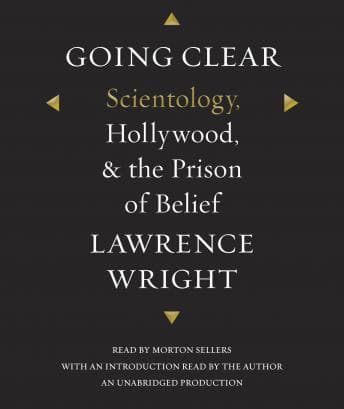
I say this not as hyperbole but as someone who spent 17 hours with Lawrence Wright's meticulous investigation playing through my earbuds while I cooked my way through an entire batch of dal makhani — the kind that takes all day, low and slow, which turned out to be the right energy for this book. Going Clear is not a quick exposé. It's a slow, patient excavation of how belief systems get built, weaponized, and defended by people who've staked their entire identity on them.
The Psychology of Inventing Yourself From Scratch
What makes this book land for me — really land — is that Wright doesn't just catalog Scientology's abuses. He traces the psychological architecture. Hubbard's childhood mythologizing, his compulsive lying about his military record, his ability to rewrite his own biography until he believed it himself — the protagonist exhibits classic grandiose narcissism with what reads like genuine dissociative capacity. The man reportedly told people he'd been blinded and crippled in World War II and healed himself through sheer mental discipline. None of it was true. But I found myself asking: did Hubbard know that by the end? Wright presents enough evidence to suggest maybe not. And that's terrifying.
Then there's David Miscavige, and the psychological shift is jarring. Where Hubbard is expansive, charismatic, a storyteller who seduced people into his reality — Miscavige is described as a control architect. Wright details accounts of Miscavige forcing senior executives into a building called "The Hole," making them play musical chairs to Queen's "Bohemian Rhapsody," with the loser being shipped to a remote outpost. If I read that in a thriller manuscript, I'd flag it as unrealistic character motivation. Too cartoonishly cruel. But the research actually shows this is consistent with how authoritarian leaders maintain power through unpredictable, theatrical punishment. You keep people afraid not through consistency but through randomness.
This is a fascinating case study in how organizations mirror the psychopathology of their founders. Scientology's structure — the auditing sessions that extract confessions, the disconnection policy that severs family ties, the billion-year Sea Org contracts — all of it maps onto coercive control models that psychologists have documented for decades. Wright doesn't use that clinical language, but I couldn't stop mapping it. My therapist would have thoughts about every single person in this book. Daniel Pink does something adjacent with regret as a psychological force in Power of Regret — different subject entirely, but the same core insight that the stories we tell ourselves about our choices are often the most coercive systems we'll ever live inside.
The Celebrity Trap and Identity Foreclosure
The sections on Tom Cruise and John Travolta hit differently when you think about identity foreclosure — the psychological concept where someone commits to an identity without truly exploring alternatives. Wright describes how the church essentially love-bombs celebrities, creating an environment so validating, so intoxicating, that leaving would mean dismantling your entire sense of self. Cruise reportedly had church members audition to be his girlfriend. The church allegedly wiretapped Nicole Kidman's phone. These aren't just wild anecdotes; they're the behavioral outputs of a system designed to make departure psychologically unbearable.
What the author understands about human nature is that people don't stay in abusive systems because they're stupid. They stay because leaving costs them everything they've built — relationships, purpose, the story they tell themselves about who they are. Wright gives enough space to the true believers, the Sea Org kids who grew up inside this world, that you feel the weight of that trap. Psychologically, this tracks completely.
Morton Sellers: Competent but Invisible
Here's where I have to be honest. The narration is... fine. Morton Sellers reads clearly, enunciates well, and stays out of the way. But for 17 hours of material this psychologically rich — material full of eccentric, volatile, sometimes genuinely unhinged personalities — I wanted more. More vocal distinction between Hubbard's manic grandiosity and Miscavige's cold intensity. More texture. Sellers delivers the information, but he doesn't inhabit it. For a book this dense, that's not a dealbreaker. But it does mean your attention has to do more of the heavy lifting, especially during the middle stretch where Wright digs into Scientology's tax exemption battles with the IRS (important context, but not exactly riveting at hour 11).
Who Gets the Most Out of This
If you're interested in the psychology of belief — why smart people join controlling organizations, how charismatic leaders manufacture reality, what happens when a religion is essentially a startup with divine aspirations — this is essential. If you want a quick, sensational takedown of Scientology, you'll be frustrated by Wright's careful, even-handed approach. He's a journalist, not a polemicist, and it shows.
I'd recommend 1.25x speed for the middle sections. The opening and closing thirds carry themselves.
The Diagnosis
Going Clear is the kind of investigative work that reminds you why long-form journalism matters. Wright doesn't psychologize — that's my job — but he gives you everything you need to do it yourself. I finished it at midnight, standing in my kitchen, dal long since eaten, thinking about how the most dangerous stories are the ones people tell themselves. And then can't stop telling.