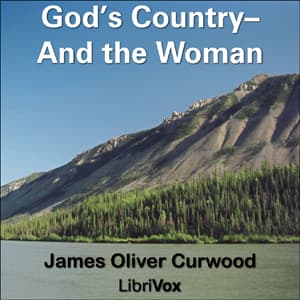

I was supposed to be debugging my procedural terrain generator at 2 AM. Instead I'm four hours deep into 1915 Canadian wilderness drama while my thesis advisor's last email sits unopened. Dr. Patel can wait. Philip Doyle just stumbled onto a woman living alone in the most remote cabin in God's Country, and I need to know what happens next.
James Oliver Curwood is one of those authors your English professor never mentioned but who sold millions of books writing about the places he actually went. The guy spent months every year in the Yukon and Alaska, and you can tell. The Canadian North in this book isn't backdrop—it's practically a character. The forests, the isolation, the way civilization just... stops existing once you're deep enough in. My D&D group would absolutely steal this setting wholesale.
Environmental Storytelling Before Anyone Called It That
The opening chapters establish this vast, indifferent wilderness that swallows people whole. Philip Doyle isn't just a protagonist—he's a man who chose to disappear into God's Country because the regular world failed him somehow. And then he finds Josephine, this mysterious woman living in complete isolation, and the mystery of why she's there drives everything forward.
The romance elements are... look, it's 1915. The pacing is different. The courtship rituals are different. But there's something genuinely compelling about two broken people finding each other in a place where society's rules don't apply. It's slow-burn in the most literal sense—a seven-hour commitment that takes its time establishing atmosphere before the adventure kicks in.
Esther's Wilderness Voice
Esther's narration is clear and steady—the kind of voice that suits long stretches of descriptive prose about frozen rivers and endless pine forests. She's not doing vocal fireworks here, but she doesn't need to. The reading feels measured, almost contemplative, which matches Curwood's atmospheric style. When dialogue comes, the distinctions are subtle rather than theatrical. You're not getting a full cast experience, but you're getting something that feels appropriate for the era and tone of the material.
The audiobook runs just over seven hours, which is actually perfect for a book like this. Long enough to sink into the atmosphere, short enough that the slower pacing doesn't become a slog. I listened at 1.0x, which felt right for the contemplative wilderness vibe.
The 1915 Problem (And Why It's Not Really a Problem)
If you're coming to this expecting modern sensibilities, recalibrate. This is a novel from over a century ago. The gender dynamics are of their time. Some of the descriptions of Indigenous characters will make you wince with modern eyes. But there's also something refreshingly earnest about Curwood's writing—he genuinely loved these wild places, and that love comes through on every page.
The "mystery and romance" promised in the description is accurate but undersells the adventure elements. There are genuine stakes here, real danger from both the wilderness and from human antagonists. The progression from "man stumbles onto mystery" to "man fights for the woman he loves" is satisfying in that old-fashioned adventure novel way. Red Rising has that same arc of escalating stakes and a protagonist willing to fight impossible odds, just with more bloodshed and less wilderness.
Roll for Wilderness Survival
This is for the fantasy and adventure readers who occasionally want something grounded but still escapist. If you've ever looked at a map of northern Canada and thought "what would it be like to just... disappear into that," Curwood wrote this book for you. It's also surprisingly good for anyone who enjoys romance with actual plot attached—the love story matters, but it's not the only thing happening.
Skip it if you need constant action. Skip it if period-appropriate attitudes toward women and Indigenous peoples are dealbreakers regardless of context. Skip it if you're looking for something to half-listen to while doing other things—this rewards attention.
Back to the Thesis (Eventually)
I finished this instead of sleeping, which is either a recommendation or a cry for help. Probably both. Curwood isn't Sanderson-level world-building—nobody is—but he's doing something similar with a real place instead of a fantasy one. Though if you want actual secondary worlds with that same sense of vast, dangerous geography, Fellowship of the Ring remains the gold standard. The Canadian wilderness as presented here feels as alien and magical as any secondary world.
At seven hours, it's a reasonable commitment. The public domain status means you can find this one pretty easily, and the audiobook format suits the atmospheric, descriptive prose. It's the kind of book that makes you want to look up cabin rentals in British Columbia even though you'd last approximately three days before missing WiFi.
My thesis remains unwritten. The Stormlight Archive audiobooks are still calling. But I don't regret this detour into God's Country. Sometimes you need a reminder that adventure fiction has roots deeper than modern genre conventions, and Curwood was one of the people who planted them.