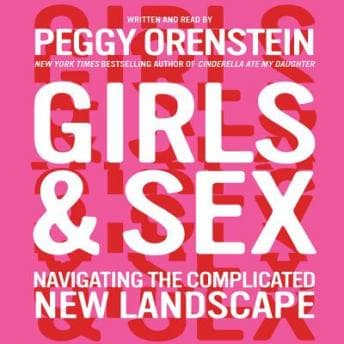

What happens when you interview seventy young women about their sex lives and then try to tell their parents about it?
I was chopping onions for a chana masala—the real kind, my mother's recipe, the kind that takes forty-five minutes of undivided attention—when Peggy Orenstein described a college freshman explaining that she'd performed oral sex on a guy at a party not because she wanted to but because it seemed easier than saying no. I put the knife down. Not because I was shocked, exactly. Because I found myself asking: why does the research on girls' sexual agency keep circling back to this same devastating pattern of performing desire rather than feeling it?
That's the central psychological tension of Girls & Sex, and it's the reason this book landed on TIME's Top 10 nonfiction list in 2016. Orenstein isn't just reporting on hookup culture or campus assault—she's documenting something more insidious. The gap between what girls say they want and what they actually experience. The disconnect between sexual confidence as performance and sexual confidence as, you know, actual internal experience.
The Protagonist Exhibits Classic People-Pleasing at Scale
Orenstein's framework here is journalistic rather than clinical, but the psychological underpinnings are solid. She draws on interviews where young women describe their sexual encounters in language that's almost dissociative—talking about their own bodies as objects to be managed for someone else's pleasure. The research actually shows this tracks with what we know about adolescent identity formation: girls are constructing sexual selves based almost entirely on external feedback loops. Social media. Porn. Peer approval. The internal compass? Barely consulted.
Where Orenstein excels is in connecting dots that most popular accounts leave scattered. She moves from the "perfect slut" paradox—where girls must be sexually available but never too sexually enthusiastic—to the way porn has essentially become default sex education, to the campus assault crisis, and she does it through the voices of actual young women rather than statistics alone. This is a fascinating case study in how cultural scripts override individual psychology, and Orenstein lets the contradictions sit there, uncomfortable and unresolved.
But. Here's where I push back. Some listeners have noted—and I agree—that Orenstein occasionally approaches her material with conclusions already formed. There are moments where the interview excerpts feel curated to confirm a thesis rather than complicate it. The section on body image, for instance, circles the same ground repeatedly without acknowledging that some of these young women might be exercising genuine agency rather than performing internalized patriarchy. Psychologically, this doesn't entirely track—human motivation is messier than any single narrative frame can contain, and Orenstein sometimes smooths out the mess.
When the Author IS the Narrator, You Get Honesty and Its Limits
Orenstein narrates her own book, and this is both the audiobook's greatest asset and its quiet limitation. The personal feel is real—when she recounts conversations with these young women, you hear the pauses, the careful emphasis, the moments where she's clearly still processing what she was told. There's an intimacy to author-narrated nonfiction that a professional narrator can't replicate, especially with interview-heavy material like this. She's not performing the text; she's remembering it.
Compared to, say, a Jon Krakauer narrating his own true crime work, Orenstein's delivery is warmer, less detached. She sounds like someone's smart aunt at a dinner party—the aunt who actually listens and then tells you something you didn't want to hear. The downside? At 7 hours and 26 minutes, the pacing occasionally sags in the middle chapters, and her reading style doesn't vary much in intensity. By hour five, I was wishing for a slightly faster tempo or a shift in energy. Cooking was done. I was just standing in my kitchen holding a bowl of chana masala, listening, wanting her to push harder.
Who Needs This (and Who'll Throw Their Phone)
If you're a parent of a teenage girl, this is probably essential listening, even if—especially if—it makes you deeply uncomfortable. If you're someone who studies adolescent psychology or gender, Orenstein provides a useful popular synthesis of research you likely already know, packaged with the kind of real-world interview data that academic papers rarely capture this vividly.
If you're looking for a balanced both-sides treatment of girls' sexuality, you will be frustrated. Orenstein has a point of view. She's not hiding it. Some readers will call this bias; I'd call it a thesis. Whether you find that clarifying or limiting depends entirely on what you're bringing to the table.
Content warning, and I mean it: frank discussions of sexual assault, coercion, and underage sexual experiences throughout. My therapist would have thoughts about listening to this without breaks. Take breaks. The emotional processing required here reminded me of what I went through with When You're Ready, This Is How You Heal—another book that asks you to sit with discomfort rather than resolve it neatly, and one I'd almost recommend pairing with this if you have the bandwidth.
My Case Notes, Filed at Midnight
This book does something important that most popular accounts of girls' sexuality don't bother with: it asks girls what they actually feel, not just what they do. That distinction matters enormously in psychology, and Orenstein mostly honors its complexity. She falls short when her journalistic instincts toward narrative coherence override the genuine chaos of human sexual development—but that's a flaw of ambition, not carelessness. Worth your time. Just don't expect it to make you feel better about anything.