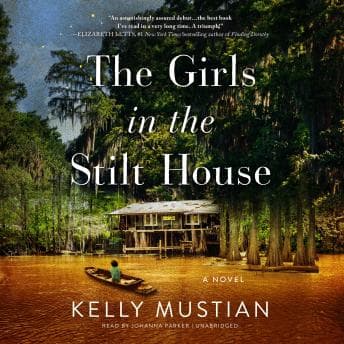

What does it take to make two teenage girls trust each other when the entire world has been built to keep them apart? That's the question sitting underneath every chapter of Girls in the Stilt House, and Kelly Mustian doesn't let you look away from it.
I found this one during Sophie's nap time stretch last week - three consecutive days where she actually slept, which felt like a miracle I wasn't going to waste. I'd been looking for something in the Crawdads wheelhouse ever since I burned through that one during a particularly brutal week of sick kids, and this one kept popping up as a comparison. Fair warning: the comparisons are accurate but also a little misleading. This is darker. More tangled. The Mississippi swamp setting isn't just atmosphere - it's almost a third character, pressing down on Ada and Matilda the way the heat presses down on everything in that world.
Two Girls, One Swamp, Zero Easy Answers
Ada is white, running back to a father she'd rather forget after her escape to Baton Rouge falls apart. Matilda is Black, a sharecropper's daughter holding her family together with both hands while quietly planning a one-way trip north. A murder pulls them into each other's orbit, and from there the book becomes about what it costs to trust someone across a divide that everyone around you says is uncrossable.
What I appreciated - and what makes this different from the Crawdads comparisons - is that Mustian doesn't romanticize the friendship. It's not a warm, fuzzy cross-racial bond that makes everyone feel good. It's two scared girls who need each other and are both very aware of exactly what that means in 1920s Mississippi. The bootlegger subplot gives the story momentum, but the real engine is that tension: how much can you lean on someone when the world punishes you both for leaning at all? Wild Women and the Blues wrestles with that same impossible weight - two people reaching across a divide the world keeps widening - and it stuck with me in a similar way. Survived 47 pauses and still made sense - which for a story this layered is genuinely impressive.
The Accent Situation (We Need to Talk About It)
Okay. Johanna Parker. She's an Audie Award winner, she has real credentials, and she clearly put effort into this performance. The pacing is solid, the emotional delivery during the heavier scenes lands, and she does distinguish between Ada and Matilda's voices in ways that help you track who's who during my inevitably fragmented listening sessions.
But. The Southern accent.
I grew up in North Carolina - not Mississippi, but close enough - and there were moments where the accent felt like it was performing at the listener rather than just existing in the story. A couple of times during my morning drop-off commute I had to rewind because I'd gotten so focused on a particular vowel choice that I missed what was actually being said. It's not a dealbreaker, and honestly some listeners won't notice or won't care. But if you're someone who gets pulled out of stories by accent choices that feel effortful, this one might work your nerves a little. I landed somewhere in the middle - appreciated the commitment, occasionally wished for a lighter touch.
Production itself is clean. No weird audio dropout, no volume inconsistencies. Just the accent thing.
The Nap Time Verdict (High Praise Edition)
At just under 10 hours, this is a genuinely manageable listen - I finished it in about five days of stolen pockets of time, which for me right now is basically speed-reading. Not groundbreaking, but sometimes you don't need groundbreaking. What you need is a story that takes you somewhere specific, with characters who feel like they're carrying real weight, and an ending that doesn't feel like the author got tired.
This delivers all three. The resolution doesn't wrap everything in a bow - it's more honest than that - but it's satisfying in the way that feels earned rather than convenient. I did not cry at school pickup, which I'm counting as a win, though I came close in the car with about 45 minutes left.
If you loved Crawdads for the atmosphere and the girl-surviving-against-the-odds energy but wanted something with more direct engagement with race and history, this is your next listen. If you need a happily-ever-after comfort read after a week of toddler chaos, maybe save this one for when you have slightly more emotional bandwidth. Car time approved - but bring your full attention.