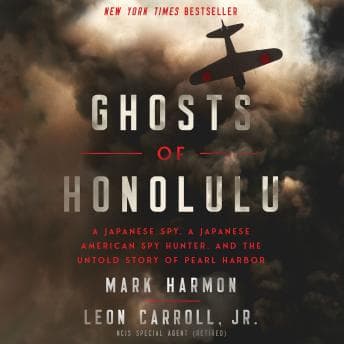

Let me cut to the chase: this book delivers intelligence work the way it actually happens - methodical, unglamorous, and absolutely critical.
I was up at 0400, couldn't sleep. Old habit from deployment days that never quite goes away. Ranger was snoring at my feet while I listened to Mark Harmon and Leon Carroll walk me through pre-Pearl Harbor Hawaii. Here's the thing - I've read probably fifty books about December 7th, 1941. Watched every documentary. But I'd never heard of Douglas Wada.
That's the real story here.
The Intel Officer Nobody Remembered
Wada was the only Japanese American agent in naval intelligence at the time. Think about that for a second. He's running counterintelligence operations, translating wiretaps on the Japanese Consulate, going undercover as a newspaper reporter - all while looking exactly like the people he's surveilling. The man was walking a razor's edge every single day, and his own country would eventually question the loyalty of people who looked like him.
Carroll's NCIS background shows in how they present the tradecraft. These aren't Hollywood spy games. It's the grunt work of intelligence - the wiretaps, the pattern analysis, the slow accumulation of evidence that something bad is coming. I've worked with intelligence professionals. This is how it actually works.
The parallel narrative with Takeo Yoshikawa, the Japanese spy operating out of the consulate, creates this slow-building tension. You know what's coming. Everyone knows what's coming. But watching these two men circle each other in the months before the attack - one trying to prevent disaster, one helping to enable it - that's genuinely compelling.
Harmon Behind the Mic - A Mixed Bag
Look, I respect what Harmon's doing here. The man clearly cares about this material, and his connection to NCIS gives him some credibility with the subject matter. But I'm going to be straight with you - his narration is flat. Not bad, exactly, but monotone in stretches that made me glad I was listening at 1.25x.
Compared to something like Erik Larson's "Dead Wake" read by Scott Brick, where the narration amplifies the tension, Harmon's delivery sometimes works against the material. He's an actor, sure, but audiobook narration is its own skill set. There were moments where the content was genuinely gripping - Wada interrogating America's first captured POW of the war, a submarine officer found on a beach - and the delivery just... didn't match the intensity.
Leon Carroll handles portions of the narration as well, and honestly, his sections flow a bit better. Makes sense - the man was an NCIS Special Agent and Marine Corps Major. He knows how to brief.
What They Got Right About the Aftermath
Here's where the book earned my respect. They don't just cover the attack and move on. They dig into what happened to Honolulu's Japanese American community afterward - including Wada's own father. The book makes a clear case that intelligence professionals in Hawaii actively worked to prevent the mass internment that California embraced.
I've seen this scenario play out in real life. After 9/11, there were plenty of people ready to treat every Muslim American as a suspect. Ordinary Men examines a similar question about how ordinary people respond when their government asks them to treat certain groups as the enemy. The professionals, the ones who actually understood intelligence work, knew that was both wrong and counterproductive. Seeing that same dynamic play out in 1941 Hawaii hit different.
The authors clearly did their homework on the historical documents. They're not inventing drama - they're excavating it from archives that have been sitting there for eighty years.
Mission Debrief
If you're an espionage buff or a WWII history junkie, this fills a gap you probably didn't know existed. The Wada story alone is worth the listen. At just under eight hours, it's not asking for a huge time commitment.
But if you need dynamic narration to stay engaged, you might struggle. This isn't a thriller with a thriller's pacing - it's history, told methodically, by people who understand that real intelligence work is about patience, not explosions. Skip it if you're looking for action-packed drama. This is the story of what happened before the bombs fell, told by people more interested in accuracy than entertainment.
Ranger approved this one - though he did fall asleep during a few of the slower stretches. Can't blame him. But I stayed awake, and I learned something. Mission accomplished.





![Steve Jobs [unabridged audiobook] audiobook cover](/_next/image?url=https%3A%2F%2Fcovers.audiobooks.com%2Fimages%2Fcovers%2Ffull%2F9788499923406.jpg&w=1920&q=75)