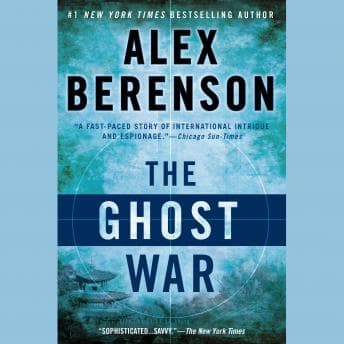

What happens when an author actually does their homework before writing about geopolitics, intelligence operations, and the kind of morally gray decision-making that keeps real people up at night? You get something like Ghost War - and you get me sitting in my driveway at 7:15 AM, engine idling, refusing to go inside and start breakfast because Alex Berenson just dropped John Wells into a Chinese power struggle that felt way too plausible for comfort.
I picked this one up after a brutal stretch of four night shifts in a row. The kind of week where you've seen too much and your brain needs something absorbing enough to override the replay loop. Carlos had the kids handled for the morning, so instead of my usual 45-minute decompress drive, I took the long way home through the desert roads east of Phoenix. The sun coming up over the Superstitions while George Guidall narrated Wells navigating a world tilting toward war? That's a vibe.
The Spy Who Actually Bleeds
John Wells is not your typical indestructible thriller hero, and that's what keeps me coming back. Berenson - a former New York Times reporter who covered Iraq - writes Wells as someone carrying real damage from The Faithful Spy. The wounds healed. The head didn't. As someone who's actually worked a code on patients who survived the physical trauma but came back fundamentally changed, I appreciate that Berenson doesn't just hand-wave the psychological aftermath. Wells needs the mission not because he's some adrenaline junkie archetype, but because he doesn't know how to exist without one. That's a character detail that lands differently when you've watched people struggle with the same thing in a hospital bed.
The China subplot is where Berenson's journalism background really shows. The internal power play driving the global chaos isn't some cartoonish villainy - it's bureaucratic, political, and disturbingly rational from every angle. The mole-within-the-CIA thread adds a layer of paranoia that kept ratcheting up through the middle hours. I won't spoil the specifics, but there's a sequence involving Wells operating in hostile territory where the tension builds so methodically that I realized I'd been white-knuckling my steering wheel for a solid ten minutes.
I did yell at my dashboard once - but not about medical accuracy this time. There's a moment where information gets passed through channels in a way that felt a little too convenient, a little too clean for the messy world Berenson usually builds. It's minor. But I noticed.
Guidall Does the Heavy Lifting
George Guidall is one of those narrators where you forget you're listening to one person. His facility with international accents is real - the shifts between American intelligence officers, Chinese officials, and Middle Eastern contacts don't feel like costume changes. They feel like different people in the room. Where he really earns it though is in the quieter moments. Wells processing his own damage, trying to reconnect with a life that doesn't quite fit anymore - Guidall plays those beats with restraint instead of melodrama, and that restraint is what makes Wells feel three-dimensional instead of just tough.
The pacing of his read matches the book's structure perfectly. Berenson writes in short, punchy chapters that alternate between multiple storylines, and Guidall shifts gears between them without losing momentum. When the action ramps up in the back third, his delivery accelerates just enough to match without tipping into breathless territory.
One thing worth noting: some listeners have reported a faint crackling background noise in certain recordings. I didn't find it distracting through my car speakers, but if you're listening on good headphones in a quiet room, it might bug you. Not a dealbreaker, but fair warning.
Who This Is For (And Who Should Bail)
If you want your thrillers grounded in real-world geopolitics rather than Hollywood set pieces, this is your lane. Berenson writes like a journalist who decided to weaponize his sourcing. If you read The Faithful Spy first (and you should - this is book two), the payoff on Wells's character arc here is worth it. The slow-build character investment reminds me of what drew me to Formidable Miss Cassidy - a completely different genre, yes, but the same patience with letting a protagonist earn your trust before the stakes fully land.
Skip this if you need constant action. The first half is a slow burn - intelligence work as it probably actually happens, which means meetings and analysis and tension that builds through information rather than explosions. It pays off. But you have to trust the process.
Perfect for that post-shift decompression when your brain is too wired for sleep but too tired for anything demanding. Twelve hours is a solid commitment, but the chapter structure makes it easy to break into shifts. Pun intended.
Night Shift Approved
Carlos asked why I sat in the driveway so long. I told him the sunrise was pretty. It was. But mostly I just needed to hear how the mole situation played out before I could let it go. That's the mark of a thriller doing its job - not shocking you, but hooking you so deep into the stakes that walking away feels irresponsible. Berenson and Guidall make a strong team here. Not flashy. Just effective. Like the best people I work with at 3 AM.