
"This is what happens when you send a politician into cartel territory without proper security."
I don't remember the exact timestamp—somewhere around hour three, maybe—but that line landed while I was walking the lakefront at dusk, and I actually stopped moving. Not because it was profound literature. Because it was so bluntly pragmatic that it felt like overhearing actual operators talk shop. That's what Scott McEwen and Thomas Koloniar do well here. They write military fiction that sounds like it came from a debrief, not a creative writing workshop.
I picked this up because one of my AP Lit students—Marcus Jr., we call him, though his real name is DeShawn—keeps trying to convince me that genre fiction deserves more respect in my curriculum. He's not wrong. And while I'm never going to teach Ghost Sniper alongside The Things They Carried, I found myself thinking about both during this listen. Thank You for My Service occupies a similar space—military experience rendered without the literary pretension, just the raw mechanics of what happened.
The Operators You'd Actually Want Beside You
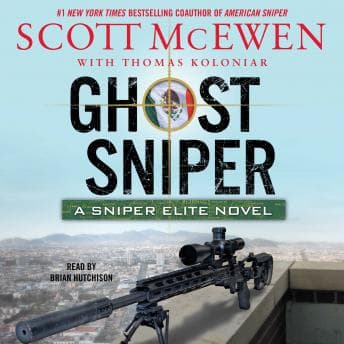
Let me be honest about what this book is and isn't. It's not trying to be literary fiction. It's not exploring the psychological toll of violence or the moral complexity of American interventionism. What it IS doing is putting you inside a world where retired Navy SEAL Daniel Crosswhite and ex-Green Beret Chance Vaught are hunting an American traitor who's become a cartel assassin.
The "Ghost Sniper" himself—this former military gunman now working for Mexico's most ruthless drug cartel—is the kind of antagonist who works precisely because he's not cartoonishly evil. He's a professional who made different choices. That restraint makes him more unsettling than any mustache-twirling villain would be.
McEwen, who co-authored American Sniper with Chris Kyle, brings that same insider credibility here. The tactical sequences feel researched rather than imagined. When Vaught calculates wind drift or Crosswhite assesses an exfil route, there's a specificity that genre fiction often lacks. My students would hate this level of procedural detail. I found it oddly meditative.
Brian Hutchison Walks a Tightrope
Here's where I need to be fair to both the narrator and the critics. Hutchison has a pleasant voice—warm, clear, the kind you'd want reading you the news during a crisis. He handles the intensity well. When scenes escalate, he escalates with them without tipping into melodrama.
But.
The pacing sometimes works against him. There are moments where the prose demands a pause that doesn't come, or conversely, where he lingers when the scene needs forward momentum. And the character differentiation—look, I've listened to enough audiobooks to know this is harder than it sounds. Hutchison gives you varied voices and accents, distinguishes between the American operators and the Mexican cartel members, but occasionally I'd lose track of who was speaking during rapid dialogue exchanges.
Some listeners apparently felt he over-acted. I didn't experience that. If anything, I'd have welcomed more vocal distinction between Crosswhite and Vaught, who can blur together when they're strategizing. It's not a dealbreaker. It's just... room for growth.
Hemingway Would Recognize This Prose
He said prose should be architecture, not interior decoration. McEwen and Koloniar write lean. Sentences that do work and get out. No lingering on sunsets or emotional introspection. Some readers will find this cold. I found it appropriate to the material.
The violence is present and unflinching—content warning there, along with language and some sexual content. This isn't a book that sanitizes what cartel warfare looks like or what operators are sometimes asked to do. If you're squeamish, this isn't your listen.
But there's something almost classical about the structure. The hero's journey, stripped of mythology and dressed in tactical gear. Bob Pope losing contact with Gil Shannon, having to pivot to Crosswhite and Vaught—it's Odysseus sending lesser heroes because the great one might be dead. I'm probably overthinking this. (Denise says I overthink everything. She's not wrong.)
Who Should Chamber This Round
If you loved American Sniper, this is its fictional cousin—same DNA, different mission. Fans of Vince Flynn, Brad Thor, or the Terminal List will feel at home here. The 10+ hour runtime demands some commitment, but the pacing keeps things moving.
Who should skip? Anyone looking for moral ambiguity or character development beyond the professional. Anyone who needs their military fiction to grapple with PTSD or the ethics of intervention. This book knows what it wants to be and doesn't apologize for it.
I listened during late-night grading sessions and lakefront walks, and it served both purposes well. Engaging enough to keep me awake at 11 PM, propulsive enough to make the miles disappear.
Class Dismissed
Ghost Sniper is competent military thriller fiction with a narrator who mostly serves the material well. It won't change your life or make you reconsider your worldview. But it will give you 10 hours of tightly constructed action with operators who feel authentic rather than Hollywood-invented.
DeShawn, if you're reading this—fine. Genre fiction has its place. But you're still reading Beloved next semester. No negotiations.