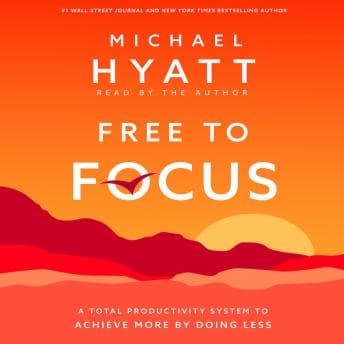

I was scrolling through my Audible library at midnight last Tuesday - post-incident-review adrenaline still buzzing, too wired to sleep but too fried to actually think - and figured, sure, let me queue up another productivity book. The irony of optimizing my productivity system instead of sleeping was not lost on me.
TL;DR: Worth your commute, but barely. Solid framework, competent narration, could've been a blog post. Or maybe three blog posts stapled together.
The "Stop, Cut, Act" Framework Actually Ships
Hyatt's core thesis breaks productivity into three stages: Stop (figure out what matters), Cut (eliminate what doesn't), and Act (execute on what's left). If you've read anything by Cal Newport, Greg McKeown, or honestly anyone in the productivity space since 2015, this will feel familiar. But here's where Hyatt earns his keep: the freedom compass exercise - where you map tasks into four zones (desire zone, distraction zone, disinterest zone, drudgery zone) - is genuinely useful. I actually paused the audiobook on the Caltrain, opened my notes app, and started sorting my work tasks. Turns out about 40% of what I do weekly falls squarely in "drudgery" territory. (Debugging flaky integration tests at 4PM on a Friday? Shocking, I know.)
The delegation framework is practical too. Hyatt doesn't just say "delegate more" like every other business book that treats delegation as a magic wand. He walks through a specific waiting-for system and how to create a delegation workflow. For someone managing a team of four engineers, that section alone was worth the listen.
But - and this is a big but - the book front-loads its best ideas. By the third stage (Act), you're getting fairly standard time-blocking and ideal-week-template advice that I've heard in at least five other audiobooks. The last 90 minutes felt like padding around a concept that was already fully explained.
Author-Narrated: The Competence Trap
Hyatt narrates his own book, and he's... fine. His voice is clear, pacing is steady, energy stays consistent. He sounds like a polished keynote speaker reading his own slides, which is basically what's happening. There's no drama to evaluate here, no character work, no moments where the narration elevates the material. It's a business book narrated by its author with the confidence of someone who's given this talk 200 times.
Compare this to, say, Chris Bailey narrating Hyperfocus where you can hear genuine excitement when he hits a research finding, or James Clear's slightly nervous energy in Atomic Habits that makes it feel intimate. Hyatt is polished to the point of being frictionless, which at 6AM on a packed Caltrain means I zoned out twice during the Act section and had to rewind. Not because it was bad - because it was smooth enough to disappear into background noise.
At 4 hours 51 minutes, I cranked this to 1.75x without missing a beat. That tells you something. This is basically Essentialism but for people who want more worksheets and less philosophy. I gave Essentialism four stars and still think about it on bad-meeting Thursdays—it's the leaner, sharper version of what Hyatt is attempting here.
Who Gets the ROI (And Who Doesn't)
Perfect for: managers drowning in tasks they shouldn't be doing, anyone who's never encountered the concept of an "ideal week," or people new to the productivity genre looking for a single structured system rather than piecing one together from twelve different books.
Skip for: anyone who's already read Essentialism, Deep Work, AND Getting Things Done. You've already assembled this framework piecemeal. The freedom compass might be worth a Google search, but you don't need five hours for it.
And honestly? If you're a senior IC or staff engineer who doesn't manage people, the delegation chapters (which eat up a solid chunk of the book) won't apply. Hyatt's world is clearly executive/leadership-oriented - he talks about assistants and direct reports like everyone has them.
The Commit Message
The ROI on this audiobook is positive but modest. It's a clean, well-organized productivity system with one genuinely good framework (the freedom compass) surrounded by competent-but-derivative material. I finished it in 2.5 commutes at 1.75x, and I've already used the desire/drudgery zone mapping in my actual work life. But I also could've gotten 80% of the value from a good summary article.
Kevin asked me what I was listening to and I said "another productivity book" and he just sighed. Fair.