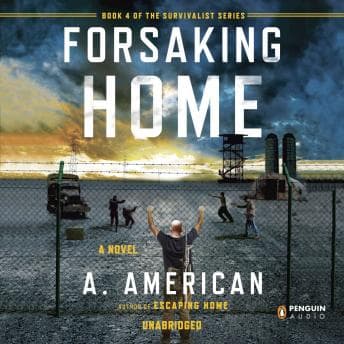

Look, I'll be honest - I came to this series late. Book 4 of a survivalist series isn't usually where I'd jump in, but sometimes you just need something that moves. Something with stakes. Something that doesn't require me to think about whether Hemingway would approve of the sentence structure.
And Forsaking Home delivered. Mostly.
When the Grid Goes Dark, the Real Story Begins
Here's the thing about post-apocalyptic fiction - it's not really about the apocalypse. It's about what we become after. A. American gets this. That same question of identity under pressure drives I Am Pilgrim, though in a very different context. Morgan Carter isn't some superhero prepper with a bunker full of MREs and tactical gear. He's a guy trying to keep his family alive while society crumbles around him. The refugee camp sections? Those hit different. The enclosed quarters, the desperation, the way injury and assault become normalized - it's uncomfortable reading. Or listening, in this case.
The dual narrative structure works surprisingly well. You've got Morgan on the outside, dealing with increasingly unstable neighbors and dwindling resources. Then you've got Jess causing chaos inside the government camp while Sarge and his crew plot something bigger. The tension builds in both storylines, and A. American knows exactly when to cut between them for maximum effect.
Is it literary fiction? No. My students would probably roll their eyes at some of the dialogue. But there's a reason this genre has such devoted fans - it taps into something primal. What would you do? Who would you become? These aren't academic questions when you're eleven hours deep into a world where the power grid is gone and the government camps are worse than what's outside.
Duke Fontaine Understands the Assignment
I couldn't find much about Duke Fontaine's background online, but based on this performance? The man knows how to inhabit a character. His Sarge is apparently legendary among series fans, and I get it now. There's a gravelly authority there that makes you believe this guy has seen things. Done things. Will do more things if necessary.
What impressed me most was the pacing. Eleven hours is a commitment - I listened over two weeks of lakefront walks with Denise, plus a few late-night grading sessions where I definitely should have been paying more attention to sophomore essays on The Great Gatsby. (Sorry, kids. Fitzgerald would understand.) But Fontaine never lets the momentum sag. The action sequences hit hard, the quieter moments breathe, and the transitions between storylines feel natural rather than jarring.
The character differentiation is solid too. You always know who's talking without the "he said, she said" crutch. That's harder than it sounds - I've abandoned audiobooks where every character sounds like the same middle-aged guy in different moods.
The Rough Edges Are Part of the Package
I won't pretend this is perfect. The writing can get a bit... functional. We're not here for beautiful prose. We're here for "will they survive the next chapter." And some of the survivalist details feel like the author is showing his homework - which, fair enough, he clearly knows his stuff about outdoor survival. But occasionally I found myself thinking "okay, I get it, you know how to purify water."
There's also violence here. Real violence, with consequences. The content warnings about assault aren't kidding around - it's handled without being gratuitous, but it's there. This isn't cozy apocalypse fiction. If you want that, look elsewhere.
But honestly? The rough edges are part of what makes it work. This isn't a polished literary exercise. It's a story about people in extremis, and it feels appropriately raw.
Who Should Press Play (And Who Should Keep Walking)
If you're already invested in the Survivalist Series, this is apparently one of the stronger entries. If you're new like me, you can follow along well enough, though you'll miss some character history. Fans of post-apocalyptic fiction, action-heavy narratives, and stories about ordinary people in extraordinary circumstances - this is your wheelhouse.
Skip it if you need beautiful sentences. Skip it if violence and dark themes aren't your thing. Skip it if you're looking for something to discuss in book club with wine and cheese. (Though honestly, the moral questions here would make for interesting discussion. What do we owe each other when everything falls apart?)
I listened at 1.0x because I'm apparently ancient, but this one could probably handle 1.25x without losing much. The action moves fast enough.
Class Dismissed
Would I listen again? Probably not - but I'm already eyeing the next book in the series. And that's the real test, isn't it? When you finish one and immediately want more.
Denise asked what I was so absorbed in during our walks. "The collapse of civilization," I told her. She nodded like that was perfectly normal. After twenty years of marriage, maybe it is.









