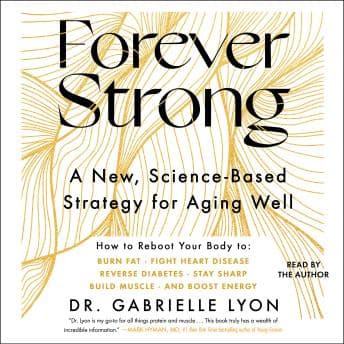

Everyone on the health internet right now is screaming about protein. Every influencer, every podcast bro, every gym TikToker. So when I picked up Forever Strong, I half-expected another entry in the "eat more protein" cinematic universe that could've been a blog post. And honestly? Parts of it ARE that blog post. But there's enough substance here that I don't regret the ~10 hours.
Let me back up. I started this one on a Saturday morning while debugging a flaky integration test from my couch (Kevin was still asleep, the apartment was quiet, I needed something that wasn't music but also wasn't fiction). The last time I had that particular Saturday morning itch for something that occupied just enough of my brain without demanding all of it, I ended up with Cry Like a Man — different subject matter entirely, but the same kind of earnest, this-guy-really-means-it energy that makes nonfiction worth the weekend hours. Health and longevity audiobooks are my weekend background listening — they pair well with tasks that need like 60% of my brain.
The Core Thesis Is Actually Good (Even If You've Heard It Before)
Dr. Lyon's central argument: we don't have an obesity problem, we have a muscle problem. Reframe the conversation from "too much fat" to "not enough muscle," and suddenly the interventions look different. Muscle as the body's largest endocrine organ — affecting insulin sensitivity, glucose disposal, immune function, even cognitive decline. She builds this case methodically, pulling from her geriatrics training at Washington University in St. Louis and her clinical practice.
The science sections are where the book earns its keep. She gets specific about leucine thresholds for muscle protein synthesis (roughly 2.5g per meal, which maps to about 30-40g of animal protein), mTOR signaling pathways, and why meal timing and protein distribution across the day matters more than just hitting a daily total. If you've read Layne Norton or listened to Peter Attia's podcast deep dives, some of this will feel like review. But Lyon packages it in a way that's genuinely accessible — she's good at the clinical anecdote-to-mechanism pipeline.
The patient stories are the strongest parts. There's this one about an older woman whose osteoporosis and frailty basically reversed with a muscle-centric protocol, and another about a younger patient cycling through autoimmune flare-ups who stabilized after changing her protein intake and resistance training approach. These aren't just "and then they felt better" stories — Lyon walks through the biomarkers, the timelines, the specific interventions.
Where It Starts Feeling Like a Brand Launch
Okay, here's where I have to be honest. A chunk of the negative reviews call this a sales pitch, and I can see why. Lyon trademarked "Muscle-Centric Medicine®" — the ® is literally in the subtitle — and there are moments where the book feels less like education and more like brand positioning. The supplement recommendations, the program structure in the back half, the repeated callbacks to her methodology. It's not egregious, but it's there, and if you're allergic to that kind of thing, it'll bug you.
The diet prescriptions also lean heavily carnivore-adjacent. She's not anti-plant, but she's pretty clearly team animal protein, and the evidence she cites for that position is... selectively presented. She'll reference studies on leucine bioavailability from animal sources without spending much time on the counterarguments or the broader nutritional epidemiology. As someone who debugs systems for a living, I notice when someone's only showing me the logs that support their hypothesis.
And yeah — some sections are one-note. The middle third drags. You get the point about muscle by hour 3, and then you get it again at hour 5, and again at hour 7. I bumped this to 1.75x for the fitness programming chapters because the information density dropped significantly.
Author-Narrated: The Trade-Off
Lyon narrates her own book, which is a double-edged sword. On the plus side: she knows her material cold, her delivery on the science sections is clear and confident, and the patient stories land with genuine warmth because she actually treated these people. You can hear the clinical authority.
On the minus side: she's not a professional narrator. The pacing is consistent to a fault — same cadence, same energy level whether she's explaining mTOR pathways or talking about her personal philosophy. No dramatic range. For a 6AM commute listen, this actually works fine because there are no jarring shifts, but it also means there's nothing pulling you forward during the slower sections. It's competent, not captivating.
Who Gets the ROI Here
Perfect for: gym sessions (obviously), weekend errands, meal prep. Skip for: bedtime (the middle will put you out, but not in the good way).
If you're new to the protein/muscle-for-longevity conversation, this is a solid entry point. Lyon synthesizes a lot of research into a coherent framework, and the practical sections — meal plans, protein targets by body weight, resistance training principles — are genuinely useful.
If you've already been down the Attia/Huberman/Norton rabbit hole, the ROI drops significantly. Maybe 30% new information, 70% stuff you've encountered in podcast form.
The Commit Message
Forever Strong is a 7/10 health book trapped in a 5/10 structure. The thesis is important, the science is mostly solid, and the practical application sections are actionable. But it needed an editor willing to cut 3 hours and a narrator willing to vary the energy. I finished it, I took some notes, I adjusted my post-workout meal timing. But I won't re-listen.