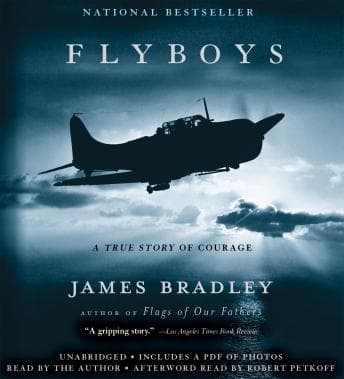

I teach juniors and seniors about the literature of war - Hemingway, O'Brien, Heller. We talk about how writers grapple with the impossible task of making violence comprehensible without making it palatable. And then I listened to Flyboys during my evening walks along the lakefront, and I had to stop. Multiple times. Not because it was boring. Because James Bradley does something I've rarely encountered: he makes you understand atrocity without letting you look away.
Let me be clear about something upfront. This is not an easy listen. The content warnings are real - graphic violence, torture, cannibalism. I'm not being dramatic. There were moments I had to pause and just watch the waves for a while before continuing. But here's the thing. If you loved Flags of Our Fathers, this is its spiritual successor - and in some ways, it's the harder, more necessary book.
The Author Knows These Men
Bradley narrates his own work, and I've seen some reviews call it monotone. I get it. He's not a trained voice actor, and there's a steadiness to his delivery that lacks the dramatic variation you might expect from professional narrators. But honestly? I think that's the right choice here. The material is so heavy, so relentlessly brutal in places, that theatrical narration would feel exploitative. Bradley understands that pause is punctuation. His even-handed approach - this clear, almost documentary tone - lets the horror speak for itself.
What he brings that no hired narrator could is knowledge. Deep, personal knowledge. This is the son of one of the Iwo Jima flag raisers, a man who grew up in the shadow of the Pacific War. When he explains the Japanese warrior code, or traces America's westward expansion to contextualize our own capacity for violence, you're not getting a performance. You're getting a lecture from someone who has spent decades in dusty attics and classified archives. My students would hate this. I love it.
Where the Narrative Shifts
Here's what surprised me. I expected a straightforward war story - brave pilots, tragic deaths, maybe some heroic rescue attempts. What Bradley delivers is something far more uncomfortable. He spends significant time - and I mean significant - building historical context. 150 years of it. He wants you to understand how both nations arrived at Chichi Jima capable of what they did.
Some listeners find this frustrating. The non-chronological structure, the jumping between American expansion and Japanese militarism, the detailed background before we even meet our Flyboys. I'll admit there were moments during faculty meetings (sorry, Principal Martinez) where I zoned out during the broader historical sweeps. But when it clicks - when you suddenly understand why these young men from American small towns were facing soldiers trained in a completely alien moral framework - it's worth every digression.
The prose deserves to be savored. Bradley doesn't moralize. He presents the fire-bombing of Japanese cities alongside Japanese atrocities. He lets you sit with the uncomfortable truth that war makes monsters of everyone, or at least creates conditions where monstrousness becomes possible. This is why we still read the classics - and why we need books like this. They refuse easy answers.
Narrative of the Life of Frederick Douglass operates in that same uncomfortable space—no easy moral victories, just the weight of truth told plainly.The Weight of What's Revealed
I won't spoil what happened to those eight Flyboys. But I will say this: the government cover-up, the sealed tribunal records, the families left wondering for sixty years - Bradley treats all of it with the gravity it deserves. The young Navy pilot who escaped, George H.W. Bush, becomes not just a historical footnote but a living reminder of how close any of them came to a different fate.
The production quality is clean - no audio issues, no distracting background noise. At 14 and a half hours, it's a commitment. I listened at 1.0x because the author chose those words, and rushing through descriptions of what happened on that island felt wrong somehow. Disrespectful.
Who Should Listen (And Who Should Skip)
Look, here's the thing. If you want light listening, skip this. If you're sensitive to graphic content, absolutely skip this. But if you're a history enthusiast who wants to understand the Pacific War beyond the sanitized version - if you want to know what Hemingway meant when he wrote about the separate peace that comes from seeing too much - this is essential.
One note: I've seen complaints that some versions are abridged. Do yourself a favor and make sure you're getting the full audiobook. This story has already been covered up once. It deserves to be heard complete.
I finished it last Tuesday, walking past the same stretch of lakefront I've walked a thousand times. Denise asked why I was so quiet at dinner. I didn't know how to explain that I'd spent two weeks with eight young men who never came home, and a government that decided their families didn't deserve to know why. Some books change how you see the world. This one changed how I teach about war.
Worth pausing the faculty meeting for. Worth pausing everything for.