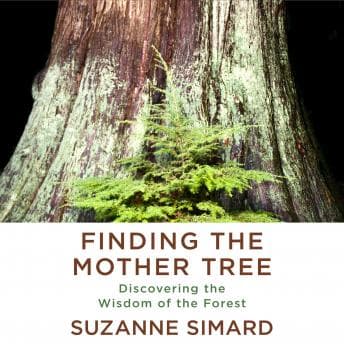

I was up at 2 AM finishing a logo rebrand that was eating my soul - you know the kind, where the client keeps saying "make it pop" and you want to scream into a pillow - and Suzanne Simard was in my ears talking about how birch trees send carbon to Douglas firs through underground fungal networks, and I just... stopped working. Set my stylus down. Stared at Diego, who was sleeping on my keyboard. Because this woman was describing how trees feed each other through their roots like it was the most natural, obvious thing in the world, and I realized I was crying about trees.
Book 48 on the crying spreadsheet. Trees.
She Talks About Mycorrhizal Networks Like They're Family
Here's what got me: Simard doesn't separate her science from her life. She grew up in logging country in British Columbia, literally playing in the stumps of cut forests as a kid, and she weaves that childhood through her research career in a way that makes you feel how personal every single experiment was. When she describes planting radioactive carbon isotopes to trace how trees share nutrients underground - injecting birch with one isotope, fir with another, then watching the Geiger counter go wild as the trees traded resources back and forth - her voice gets this breathless quality. Like she's still standing in that forest, still shocked it worked.
And then she'll pivot from that scientific high to talking about her divorce, or her breast cancer diagnosis, or raising her daughters as a single mom while fighting the logging industry and her own academic establishment. The pacing between science and memoir isn't always smooth - there are stretches where the forestry methodology gets dense and I had to rewind a few times because my brain wandered - but when she lands an emotional beat, she LANDS it.
The Mother Tree concept itself wrecked me. The idea that the oldest, largest trees in a forest actively nurture their offspring and neighbors through root networks, sending them sugars and warnings about disease, prioritizing their own kin - and that when a Mother Tree is dying, she dumps her carbon reserves into the network for the younger trees around her. She's giving everything she has left to her children.
Abuela would have loved this one. She would have nodded and said "pues, claro" - obviously trees are mothers. Obviously they take care of their babies. She wouldn't have needed the science.
Suzanne Simard Reading Her Own Story Hits Different
Okay so I need to talk about Simard narrating this herself because it's doing something really specific. She's not a professional narrator. You can tell. There are moments where her pacing is a little uneven, where a trained voice actor would've paused differently or hit a word with more precision. But here's the thing - when she describes the smell of a forest after rain, or the feeling of digging her hands into soil to find fungal threads, her voice has this lived-in richness that no actor could fake. You can hear that she's been there. She's touched those trees. Her vocal tone shifts when she's talking about a clearcut versus an old-growth stand and it's not performance, it's memory.
The emotional sections - particularly around her cancer treatment and the parallel she draws between her own body fighting disease and a forest recovering from disturbance - have this quiet intensity. She doesn't oversell it. She just... tells you. And her voice cracks in exactly the right places because they're real cracks.
At 1.0x she's comfortable, measured. I can see why some people bump to 1.25x during the heavier science chapters, but I wanted to sit with her cadence. It felt like listening to a professor you actually like telling you the real story after class.
Who Needs This in Their Ears
If you need plot twists and cliffhangers, this isn't your book. If you want to feel connected to something bigger and older and quieter than your own anxious brain at 2 AM - God, yes. Listen to this. This book felt like pressing my forehead against a window on a cold day. Grounding. A little painful. Necessary.
People who loved Braiding Sweetgrass will find a companion here, though Simard is more Western-science-framework than Kimmerer's Indigenous knowledge approach. I've been chasing that same feeling of stumbling into a story bigger than you expected — First Ladies did something similar for me, where the personal and the structural kept colliding in ways I didn't anticipate. People who are going through something hard - grief, illness, feeling cut off - the metaphor of the underground network, of invisible connections sustaining life you can't see, is going to hit you somewhere you didn't expect.
Skip if you have zero patience for scientific methodology. There ARE stretches about experimental design and forestry policy that require your full attention. Frida knocked my phone off the desk during one of these sections and I honestly didn't rush to pick it up.
My Heart is a Mycorrhizal Network Now
Twelve hours with this woman in my ears changed how I look at the oak tree outside my apartment window. That's not nothing. That's the whole point of a book - to make you see something you looked at every day and finally actually see it. My heart. MY HEART.