
I was sitting at the dining room table at 10:30 PM, staring down a stack of sophomore essays on The Great Gatsby, desperate for literally any word other than "good" or "bad" to describe Nick Carraway. (Seriously, if I read "Nick is a very good narrator" one more time, I'm going to throw myself into Lake Michigan.)
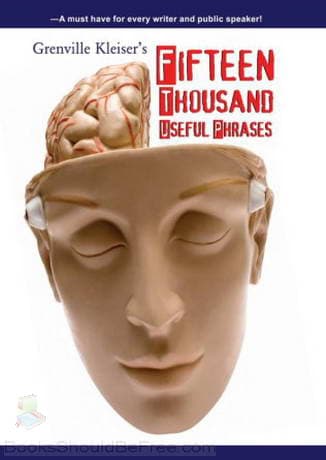
So, naturally, I turned to this audiobook. Fifteen Thousand Useful Phrases. It sounded like the holy grail. A Yale professor, Grenville Kleiser—a guy who taught divinity students how to speak without putting the congregation to sleep—listing off "striking similes" and "literary terms"? Sign me up. I thought I could let it wash over me, osmosis-style, maybe pick up a few gems to drop in the faculty lounge to make Principal Martinez think I'm smarter than I am.
The Audio Disaster
Here's the thing about audiobooks—I usually defend them to the death. But this? This tested my faith. I've heard "Various" narrators pull off magic before—World War Z: The Complete Edition had like a dozen voices and somehow nailed every single one—but this ain't that.
The research notes warned me. One review said it sounds like the narrator is "reading whilst mowing the lawn." I laughed when I read that. I'm not laughing anymore. Scary accurate.
The audio quality isn't just "lo-fi" or "vintage." It's actively hostile. There's this persistent hum, static, and background chaos that makes you wonder if the recording booth was actually a phone booth on a busy corner in 1942. For a book entirely about the beauty of language, the delivery is... well, ugly. You have this text begging for a booming, resonant voice—something theatrical, something with gravitas—and instead, you get audio that sounds like a hostage proof-of-life video.
A Goldmine Wrapped in Tinfoil
Which is a tragedy, honestly. Because Kleiser's content? It's magnificent.
If you can tune out the lawnmower-man (and that's a big if), the actual words are poetry. It's not just a thesaurus. It's a collection of ways to elevate your speech from "grunt" to "oration."
I caught snippets—between the static—of phrases that made me want to pause and write them down. It's the kind of stuff I try to teach my AP Lit kids. The difference between saying "he was happy" and describing a "radiant and infectious joy." Kleiser understands that words are tools, but he treats them like jewels.
But listening to a list of phrases is already a hard sell. It requires focus. When you add the audio friction, your brain just slides right off. I found myself zoning out, then realizing I'd missed 400 useful phrases and was just listening to the hiss of the recording.
The Verdict: Skip the Audio, Find the Book
Look, I love the idea of this. As an English teacher, I want this book on my desk. I want to throw it at my students when they use "nice" to describe a sunset.
But as an audiobook? Hard pass.
The format fights the content. You can't really "listen" to a reference book, especially not one produced like this. You need to see these words. You need to flip through the pages, find the "Commercial" section or the "Conversational" section, and pick your weapon.
Who should listen: Honestly? Almost no one. Maybe completists who collect public domain audio oddities, or folks who genuinely enjoy lo-fi background noise while they work. Who should skip: Anyone actually hoping to absorb these phrases—which is, you know, the entire point.
Do yourself a favor. Skip the download. Go find a dusty physical copy in a used bookstore. Smell the old paper. Read the phrases out loud to yourself in the mirror. You'll sound way smarter, and you won't have to listen to someone mowing their lawn.