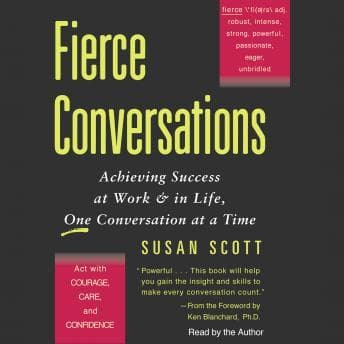

Look, I need to rant for a second. I am so tired of business books that take one good idea, stamp the word "fierce" on it, and then build an entire framework of numbered steps and principles around it like they're constructing IKEA furniture. Susan Craig Scott's Fierce Conversations does exactly this, and it drove me a little crazy on my Saturday morning run.
Here's the thing though - the core idea? It's actually solid. And that's what makes the padding so frustrating.
My Parents Had Fierce Conversations Every Tuesday Night Over the Books
The central premise is simple: the conversation IS the relationship. Not a tool for the relationship. Not a step toward the relationship. The conversation itself is the thing. Scott argues that every conversation you have either moves you toward or away from the results and relationships you want.
This is what my parents did instinctively. Now it has a TED talk.
My dad never read a book about "interrogating reality" - Scott's term for getting to the truth of what's actually happening in your business or your marriage. He just sat down with suppliers, looked them in the eye, and said what needed to be said. No mineral rights metaphor needed. (Scott uses this mining metaphor repeatedly - the idea that you need to dig beneath the surface of conversations to find the real ore. It works the first time. By the fifth time, you're begging her to find a new vein.)
The seven-step "Mineral Rights" conversation model is the book's strongest framework. You identify the most pressing issue, clarify it, determine its current impact, figure out your role in creating it, describe the ideal outcome, commit to action, and determine what happens if nothing changes. That's legitimately useful. I've already adapted a version of it for a founder I'm coaching who keeps having the same unproductive board meetings.
5 Hours That Should've Been 2.5
At 5 hours, this is mercifully shorter than most business books - but it still felt padded. Scott layers principle on top of principle: the Decision Tree model, the Confrontation Model, the Beach Ball model (different perspectives = different colored stripes on the ball... okay, Susan, I get it). Each one gets its own setup, explanation, example, and recap. By hour 3, I was toggling between 2.0x and 2.5x just to push through what felt like a leadership seminar that forgot to schedule a break.
Scott narrates her own book, and here's where it gets interesting. She's clearly a polished speaker - decades of corporate training will do that. Her delivery is authoritative and measured, which suits the material. But that same polish creates a distance. She sounds like she's presenting to a conference room of Fortune 500 executives, not talking to you. There's no vulnerability in the delivery, which is ironic for a book about authentic conversation. She tells you to "come out from behind yourself into the conversation," but her narration never quite does that.
No sound effects, no music, no production flourishes. Just Scott talking at you for five hours. Straightforward. Fine for what it is.
The Gap Between "Fierce" and "Formulaic"
Here's my real issue. Some listeners call this book formulaic, and they're right - but I think the problem runs deeper than too many numbered steps. The book wants you to believe that if you follow its models, you'll transform your relationships and your career. I've seen this fail at three different companies. Not because the frameworks are wrong, but because fierce conversations require something no model can give you: the willingness to hear answers you don't want.
Scott touches on this - she talks about embracing silence, sitting with discomfort, not filling every pause. Good stuff. But she breezes past it to get to the next framework instead of sitting in that discomfort herself. The book tells you to be brave and then hands you a safety net made of acronyms.
That said - the section on emotional wake is genuinely useful. The idea that every conversation leaves an emotional residue, and that you're responsible for the wake you leave behind? That hit differently while I was cooling down from my run, heart rate dropping, thinking about a tough conversation I'd been avoiding with a client. Sometimes the right idea at the right time is enough.
Who Gets ROI on This Credit
If you're a mid-career manager who's never been taught how to have hard conversations - the kind where you tell someone their performance is tanking, or you confront a co-founder about a strategic disagreement - this book gives you scaffolding. Not perfect scaffolding, but scaffolding.
If you've already read Crucial Conversations or Radical Candor, you're going to hear a lot of familiar notes played in a slightly different key. The Power of Now scratches a related itch if what you're actually after is that discomfort-sitting practice Scott keeps promising but never fully delivers — Tolle spends the whole book in that uncomfortable silence instead of handing you an acronym to escape it. Skip to the Mineral Rights framework (early chapters), grab the emotional wake concept, and move on with your life.
Bottom line: 45 good minutes of insight in a 5-hour package. The core idea earns its keep. The delivery and the framework overload don't quite match the "fierce" promise on the tin. Jenny would say I'm being harsh. Jenny is right. But I'm also not wrong.









