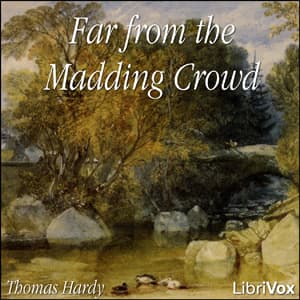

I've spent two decades telling students that Hardy is worth the effort. That the Victorian prose rewards patience. That Wessex is a real place if you let it be. And then I assign them excerpts from Far from the Madding Crowd and watch their eyes glaze over like donuts at a faculty breakfast.
So there's a certain irony that I finished this LibriVox production at 1 AM on a Tuesday, grading forgotten while Bathsheba Everdene made her final choice, and I thought: my students would hate this. I loved it.
The Gamble of Volunteer Voices
Here's what nobody tells you about LibriVox productions—they're not audiobooks in the polished, Audible-studio sense. They're community theater. Some chapters, you get the equivalent of that one drama teacher who actually trained at Juilliard. Others, you get the well-meaning parent who volunteered because nobody else would.
This version of Far from the Madding Crowd has both. Some readers understand that Hardy's "common folk"—the rustics gossiping at Warren's Malthouse, the farmhands debating sheep rot—require a specific kind of delivery. Not patronizing. Not mockery dressed as dialect. Just... lived-in. Those chapters were genuinely joyful. The prose deserves to be savored, and certain readers here get that.
But then you'll hit a chapter where the reader sounds like they're reading a grocery list. The shift is jarring. Bathsheba in one chapter has fire and foolishness in her voice. In the next, she sounds like someone's aunt reading aloud at a family reunion because she lost a bet.
I kept a mental tally. Roughly two-thirds of the chapters range from solid to excellent. The remaining third are... serviceable. Average. The kind of reading that makes you realize how much a great narrator actually does.
Why Bathsheba Still Matters (And Why Hardy Knew It)
Hemingway said the dignity of an iceberg comes from only one-eighth of it being above water. Hardy's doing something similar with Bathsheba. On the surface, she's making catastrophically bad romantic decisions. Sending that valentine to Boldwood. Choosing Troy. The plot mechanics feel almost melodramatic.
But underneath? Hardy's writing one of the first genuinely complex portraits of a woman who refuses to be defined by marriage. In 1874. When the other option was basically "be a governess or die in a workhouse."
Virginia Woolf called this book proof that Hardy got the subject right, the method right. She wasn't wrong. Bathsheba runs a farm. She makes payroll. She negotiates with merchants. And yes, she makes terrible choices about men—but Hardy never suggests she's stupid for it. Just young. Just human. Just learning.
The audio format actually helps here. At 14-plus hours, you live with Bathsheba's decisions. You watch her grow up. By the time Gabriel Oak finally gets his moment—and you know it's coming, Hardy isn't exactly subtle—it feels earned in a way that a quick read might miss.
The LibriVox Trade-Off
Let's be honest about what you're getting. This is free. Completely free. No subscription, no credit, no catch. And for that price, you're getting a legitimate classic performed by people who genuinely love literature enough to record themselves reading it for strangers.
The same volunteer spirit shows up in the LibriVox recording of War and Peace, Book 01: 1805—a production I kept returning to despite its own uneven chapters, precisely because the love for the source material bleeds through every imperfect page.The trade-off is consistency. There's no music, no sound effects, no professional audio engineering. Some chapters have slightly different recording quality. The multiple-reader format means you're essentially getting a different interpretation every few chapters.
For some listeners, that's a dealbreaker. I get it.
But here's what I kept thinking during my late-night grading sessions, Hardy's Wessex unfolding in my earbuds while I marked yet another essay about The Great Gatsby: this is how literature used to work. Stories told by different voices around different fires. The inconsistency is almost... authentic?
(Principal Martinez, if you're somehow reading this review, I was definitely grading during that budget meeting. I was not listening to a Victorian novel about sheep farming and romantic tragedy. That would be unprofessional.)
Who Should Brave the Madding Crowd
If you already love Hardy, this production will work for you. The good chapters are genuinely good, and you'll tolerate the average ones because you know what's coming.
If you're new to Hardy? I'd actually recommend this as a gateway. The price is right—literally free—and the format forces you to slow down. Hardy's prose isn't meant to be rushed. The long descriptions of sheep-shearing, the detailed accounts of agricultural crisis, the way weather becomes character—it all needs room to breathe.
Skip this if you need polish. If uneven narration will pull you out of the story completely. If you're looking for a single voice to guide you through Wessex.
But if you're willing to treat it like what it is—a community effort to keep classic literature alive and accessible—there's real value here.
Class Dismissed (But the Book Stays With You)
I've listened to plenty of audiobooks. Professional productions with celebrity narrators and full orchestral scores. And I've listened to LibriVox recordings that sound like someone's reading into a phone from a closet.
This falls somewhere in the middle, leaning toward the better end. Hardy's novel survives the format. More than survives—in places, it thrives. The rural scenes feel genuine. The tragedy lands.
Though I'll admit, after 14 hours of Hardy's slow-burn tragedy, I did find myself reaching for something darker—I ended up with Best Horror of the Year Volume 10, which turns out to be its own argument for patient, attentive reading.My students would still hate it. They'd complain about the pace, the vocabulary, the fact that nothing explodes.
But that's why we still read the classics. They teach us patience. They reward attention. And sometimes, at 1 AM with a stack of ungraded papers, they remind us why we fell in love with literature in the first place.