
"Every citizen was free to believe absolutely anything, or to pretend to be absolutely anybody."
That line hit me somewhere around hour three, sitting in the parking lot of a client's office building in Round Rock, fifteen minutes early for a threat assessment meeting. I turned off the engine and just sat there, Ranger panting in the back seat, thinking about every conspiracy theory I've heard a grown adult defend with a straight face. And I've heard a lot of them - in briefing rooms, in mess halls, in boardrooms.
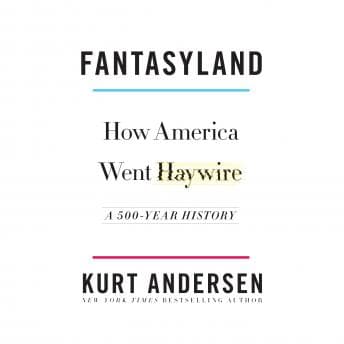
Let me cut to the chase: Andersen's thesis is that America didn't suddenly go crazy. We were born crazy. And he builds his case with 500 years of evidence that's pretty hard to argue with.
The Longest Intelligence Brief You'll Ever Sit Through
Nineteen hours and thirty-six minutes. That's longer than my flight from Ramstein to Bagram. And much like that flight, you need to commit. This isn't background listening while you're doing dishes. Andersen starts with the Puritans - who were, let's be honest, religious extremists by any modern definition - and traces a direct line through the Salem witch trials, P.T. Barnum's carnival of suckers, the gold rush dreamers, Hollywood mythmaking, the '60s counterculture, the Satanic Panic (which I remember scaring the hell out of my mother), Scientology, anti-vaxxers, and ultimately to the 2016 election.
The structure is chronological and relentless. He's building a prosecution's case, exhibit by exhibit. Some chapters had me nodding along - his breakdown of how the 1960s simultaneously produced both the free-love left AND the evangelical right's fantasy worldview was genuinely sharp. The argument that radical individualism plus religious fervor plus entertainment culture created a uniquely American relationship with reality? That's a clean shot, center mass.
But here's the thing - at nearly 20 hours, there are stretches where you feel every minute. The colonial-era sections, while necessary for his argument, drag. I found myself bumping to 1.5x through parts of the 17th and 18th century material just to get to the meat. The book picks up serious momentum once he hits the 20th century, and by the time he's connecting the dots between talk radio, reality TV, and political fantasy, it's firing on all cylinders.
When the Author Reads His Own Manifesto
Andersen narrates this himself, and I have mixed feelings. On one hand, you can hear the barely-contained rage and bewilderment in his delivery. When he's cataloging the sheer volume of Americans who believe in angels (like, literal angels - we're talking a majority of the population), there's this dry incredulity in his voice that works. He sounds like a smart guy at a dinner party who's had two bourbons and finally decided to say what he's been thinking for twenty years. The Untethered Soul narrator had that same quality - someone so personally invested in the material that the conviction carries even when the delivery isn't polished.
On the other hand, he's not a professional narrator. His pacing is uneven - sometimes rushing through dense historical passages, sometimes lingering on points he's clearly proud of. No distinct character voices, obviously, since this is nonfiction, but some of the quoted material blends into his own commentary in ways that had me rewinding to figure out who was talking. He's engaging enough to carry it, but a seasoned narrator might have given the material more dynamic range.
Where the Mission Gets Political
I need to be straight with you. Andersen has a clear political perspective, and the Trump chapters make it explicit. If you're looking for a balanced "both sides" analysis, this isn't it. He's specifically arguing that the right has embraced fantasy more aggressively than the left over the past few decades, though he does take shots at left-wing magical thinking too - New Age crystal healing, anti-GMO hysteria, the "everyone gets a trophy" mentality.
I've seen this scenario play out in real life - I've watched intelligent people believe things that were demonstrably false because it felt right or confirmed what they wanted to be true. Andersen's argument that this tendency is baked into the American experiment from day one is uncomfortable regardless of where you sit politically. And uncomfortable is usually where the useful intelligence is.
The weakness? He sometimes conflates harmless eccentricity with dangerous delusion. A guy who believes in Bigfoot and a guy who believes Sandy Hook was staged are operating on fundamentally different levels of harm. Andersen acknowledges this in passing but doesn't always maintain the distinction.
The Debrief
Worth your time? Here's the debrief: If you can handle 20 hours of someone methodically dismantling the idea that Americans are uniquely rational, and you don't need your nonfiction to be politically neutral, this is a significant listen. The author did his homework - the bibliography alone would keep you busy for a year. It changed how I think about some things I took for granted about this country, and that's not nothing.
But go in knowing it's long, it's got a clear editorial slant, and the author-narration is competent rather than exceptional. I'd have cut four hours and it would've been tighter. Ranger fell asleep during the Puritan chapters. Can't say I blame him.