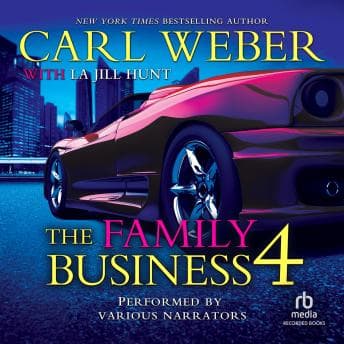

People keep telling me Carl Weber's Family Business series is the literary equivalent of a prime-time soap opera. They say this like it's an insult. I've been teaching English for twenty years, and I'll tell you what — there's a craft to melodrama that most people refuse to respect. Dickens was melodramatic. Shakespeare was melodramatic. Weber isn't Dickens, but the man understands what serialized family fiction is supposed to do: make you care about deeply flawed people doing increasingly reckless things.
So here I am, fourth book deep in the Duncan family saga, listening at 11 PM while grading a stack of persuasive essays about social media addiction (the irony), and I'm genuinely invested in whether LC Duncan's near-death experience will actually change anything about how this family operates. Spoiler: the Duncans don't do peace. They do temporary ceasefires.
Thirteen Narrators Walk Into a Recording Booth
Let's talk about the elephant in the room. This audiobook has thirteen narrators. Thirteen. That's more voices than my third-period class on a Monday morning. And here's the thing — it mostly works. The full-cast approach gives every character their own physical presence, which matters in a book where you're juggling LC, Chippy, Orlando, Vinnie Dash, Ruby, and about a dozen other people with competing agendas.
The standout for me was the energy shift between the Duncan family scenes and the antagonist chapters. When Vinnie Dash enters the picture, you feel the temperature drop. The narrators playing the family members carry this warmth, this lived-in familiarity with each other — like they've been at Thanksgiving dinner together and know exactly who's going to start the argument over the last piece of sweet potato pie. Then the threat actors come in with a different register entirely. That contrast does real work for the story's tension.
But thirteen narrators also means thirteen styles, thirteen pacing instincts, thirteen ideas about how dramatic a pause should be. Some transitions between narrators feel smooth. Others feel like someone changed the radio station mid-song. It's not bad production — the audio quality is clean throughout — but the cohesion wobbles in spots. You adjust. By hour three, your ear has calibrated.
The Waycross Reunion and Why the Duncans Can't Have Nice Things
The setup here is deceptively simple: LC and Chippy survive a shooting, reflect on their lives, and decide to go back to Waycross, Georgia for a family reunion. That's it. That should be a Hallmark movie. But Weber and Hunt know their audience, and they know the Duncans. A family reunion for this clan is just a more scenic venue for chaos.
What keeps me listening — and I mean genuinely listening, not just having it on while I write margin notes about thesis statements — is the way the book handles the collision between family loyalty and individual ambition. Ruby's storyline, the disappeared mother of Orlando's baby, isn't just plot mechanics. It's a question about who gets to define family, who gets invited to the table, and what happens when blood ties conflict with the family's power structure. Weber's been building this theme across four books now, and while it's not subtle, it hits because the Duncans feel specific. They're not generic rich-people-with-problems. They're a particular Black family with a particular history, and the Waycross setting grounds all that drama in place and memory. That grounding in specific cultural identity is something I kept coming back to in The Hate U Give too — the story only lands because it's not trying to be universal, it's trying to be true to one particular community's weight and history.
Now. Some listeners are frustrated with the direction La Jill Hunt has taken the series in these later installments, and I get it. There's a shift in emphasis — more sprawl, more subplots competing for attention. The Ruby thread and the Vinnie Dash thread don't always feel like they belong in the same book. At ten hours, it doesn't drag exactly, but there are stretches in the middle where you can feel the plates spinning rather than the story moving.
Who Should Be at This Reunion
If you've been with the Duncans since book one, you already own this. You're not here for my permission. If you're new to the series — don't start here. Go back to the beginning. The family dynamics only land if you've watched them build. And if you're the kind of listener who needs literary fiction pacing with careful interiority, this isn't your book. But if you want a family saga that moves, that gives every character a voice (literally, in this case), and that understands the addictive pleasure of watching people you love make terrible decisions — the Duncans will take you in.
My students would actually like this one. I'm not sure what that says about my students or about me.
The Annotation in the Margin
I finished this at 12:47 AM, papers half-graded, red pen still in hand. It's not the kind of book I'd podcast about — my 47 listeners expect me to talk about Middlemarch, not the Middletown of urban family drama. But good serialized storytelling is good serialized storytelling, and Weber knows how to end a chapter so you don't press pause. The full-cast narration elevates material that could feel flat on the page, even when thirteen voices occasionally step on each other's toes. Worth your time if you're already invested. Worth your curiosity if you're not.









