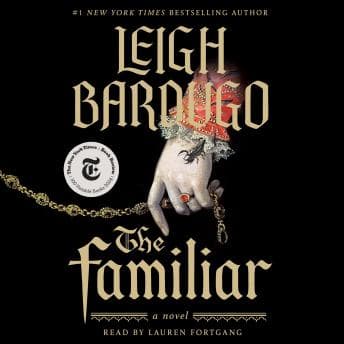

I was supposed to be debugging my procedural dungeon generator. Like, actually supposed to be. Dr. Patel had sent me one of those emails with the subject line "checking in" which is academic-speak for "I'm losing faith in you, Tom." But I'd just finished a long stretch of staring at broken tile-placement logic, and I told myself I'd listen to one chapter of The Familiar while I ate leftover pad thai. That was around 7 PM. I looked up and it was midnight and my pad thai was cold and I'd listened to five hours straight.
So yeah. I read this instead of writing my thesis. Again.
Bardugo Left the Grishaverse and Found Something Sharper
Here's the thing about Leigh Bardugo — I liked the Grishaverse books, but they always felt like they were operating within a YA framework even when they wanted to be darker. The Familiar is what happens when she takes the leash off. This is set in 1580s Madrid during the Spanish Golden Age, and it's not playing around. Luzia Cotado is a scullion — basically the lowest rung of household servants — who's hiding two dangerous secrets: she's got converso blood (Jewish heritage in Inquisition-era Spain, which is exactly as terrifying as it sounds), and she can do small magic. Little miracles. She uses scraps of old songs, refranes, to restore stale bread or mend a torn dress. The magic system is chef's kiss — it's rooted in language and memory and heritage, not flashy fireballs. Every spell Luzia casts is an act of cultural preservation disguised as domestic labor. My D&D group would love this — it's like if your bard's cantrips were tied to their backstory in a way that actually mattered mechanically AND narratively.
The world-building here is dense but earned. Bardugo clearly did her homework on Philip II's court, the power games between the king and his disgraced secretary Antonio Pérez, the paranoia of the Inquisition. There are alchemists, seers, holy men, and con artists, and the book never quite lets you be sure which category anyone falls into. If you don't like info-dumps, this isn't for you (but you're wrong) — though honestly, Bardugo weaves the historical context into the plot rather than front-loading it. You learn about the political landscape because Luzia is being pulled into it against her will, not because someone stops to deliver a lecture. That kind of earned political immersion is something I also ran into with Hellfire Club, where the historical machinery closes in on the characters so gradually you don't realize how trapped they are until it's too late.
And then there's Santángel. An immortal familiar bound to serve, cold and guarded and carrying centuries of bitterness like a second skin. His dynamic with Luzia is a slow burn that actually earns its payoff. The progression is satisfying — you feel the walls coming down conversation by conversation, and when tenderness finally cracks through his gruffness, it hits different because you've spent hours listening to him be ice.
Lauren Fortgang Understood the Assignment
Look, I'm the guy who thinks Steven Pacey walked so other narrators could run, so my bar is high. Fortgang doesn't do Pacey-level theatrical transformation, but what she does is arguably harder — she makes Bardugo's prose breathe. The writing in this book is lush. Borderline ornate in places. In the wrong narrator's hands, that turns into purple mush. Fortgang finds the rhythm in it and lets the sentences land without overselling them.
Her Luzia is smart and frustrated and quietly fierce, and you can hear the difference between Luzia performing servility for her mistress versus Luzia speaking honestly to Santángel. The shift is subtle — a slight tightening in the voice, a dropped register — but it's there. And her Santángel goes from this flat, detached monotone early on to something warmer and more fractured as the story progresses. It's not showy voice-acting. It's character work.
The Spanish names and terminology flow naturally, which matters more than you'd think in a book this steeped in a specific time and place. No stumbles, no Americanized pronunciation that yanks you out of 16th-century Castile.
Who's Rolling Initiative and Who Should Sit This One Out
If you want Sanderson-level magic systems with hard rules and clear limitations — pump the brakes. This is softer magic, more atmospheric, more tied to faith and culture than to physics. And the romance is a slow burn, not a subplot that charges in swinging. Some folks found it generic or shoehorned, and I get that complaint if you're expecting the breakneck plotting of Six of Crows. This is a quieter book. A more dangerous book, in a way, because the stakes are survival under an empire that wants to erase who you are.
But if you want This is Sanderson-level world-building — not in the mechanical sense, but in the "I can smell this city and feel the political pressure closing in" sense — you'll be right at home. This is a 13-hour listen that rewards focused attention. Don't try to background this one while doing dishes.
Tom's Thesis Can Wait Another Week
I went into The Familiar expecting Bardugo doing adult fantasy as a brand extension. What I got was something with real teeth — a story about power, erasure, and the tiny rebellions of people who refuse to let their history be burned out of them. Fortgang carries it beautifully. Yes, it's not a 40-hour epic. But it doesn't need to be. Every hour earns its keep.