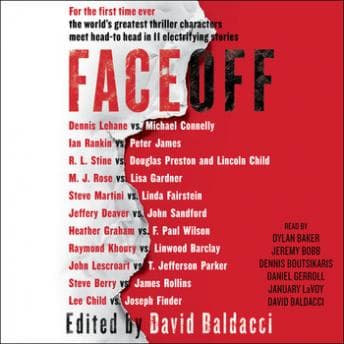

Jack Reacher and Nick Heller in the same story. That sentence alone made me download this without reading another word of the description. I was on the treadmill at 6 AM, which is either dedication or insanity depending on your perspective, and I needed something that would make 45 minutes disappear. FaceOff delivered. Mostly.
Let me set expectations correctly because the anthology format here is doing something genuinely unusual - this isn't a 'best of' collection where authors write solo. These are co-authored crossover stories where fictional universes actually collide. Harry Bosch meets Patrick Kenzie. Lincoln Rhyme goes up against Lucas Davenport. That's a fundamentally different premise than your standard short story collection, and it creates a specific problem: when two authors with distinct voices write one story together, whose voice wins?
The Hits Are Real Hits
The Lehane/Connelly pairing in 'Red Eye' is the standout, full stop. Kenzie and Bosch on a cross-country flight, both working angles on the same case without initially realizing it - it's the kind of setup that sounds like fan fiction but reads like two writers who genuinely respect each other's characters. Bosch's methodical, LA-baked worldview grinding against Kenzie's Boston-street instincts creates actual friction, not just clever cameo placement. You feel both authors fighting for their guy, which is exactly what you want.
The Deaver/Sandford story - 'Rhymes With Prey' - is the other one worth your full attention. Lincoln Rhyme and Lucas Davenport are both procedural giants but they're procedural in completely different ways. Rhyme is pure forensic chess, Davenport is controlled aggression. Watching those methodologies clash is the kind of thing that makes you want to go back and read both series from scratch. (I won't. But I wanted to.)
The R.L. Stine/Preston & Child entry - Slappy the Ventriloquist Dummy versus Pendergast - is either the most inspired or most unhinged pairing in the collection. I genuinely cannot decide. It works more than it should. The tonal whiplash between Stine's campy horror and Preston & Child's gothic menace shouldn't hold together, but somehow the sheer absurdity commits hard enough to earn it.
Where the Model Shows Its Cracks
Here's the honest problem with co-authored crossovers at scale: the weaker pairings feel like contractual obligations. A few stories read like the authors agreed on a plot outline, split the word count, and called it done. The characters show up, exchange competent thriller-dialogue, solve something, and leave. No real tension between the universes. No sense that these two people shouldn't exist in the same story. That gap between promising premise and flat execution is something I kept thinking about while reading Simple Truth, where a similarly ambitious setup never quite delivers the friction it earns on paper.
This is what I've seen fail at three different companies when they try to force collaboration between strong individual performers - you don't automatically get synergy, you sometimes just get two people in the same room. Some of these author pairings feel exactly like that.
The multi-narrator approach is the right call for this format - six narrators handling eleven stories means each story gets a voice that at least roughly matches its tone. Dylan Baker's work on the darker entries is notably controlled. January LaVoy handles the stories she's assigned with real authority. David Baldacci narrating his own editorial introduction is a nice touch that grounds the anthology's concept before you dive in. What I can't tell you with precision is which narrator handled which story consistently, because the handoffs aren't always announced clearly - which is a minor production complaint but a real one for a collection this size.
At 10 hours 51 minutes, this is actually a reasonable length for eleven stories. That's roughly an hour per story, which is enough space to do real work without overstaying. The pacing problem isn't runtime, it's inconsistency - the quality gap between the best and weakest entries is wide enough that you'll feel it.
The ROI Calculation
Here's my actual math on this: you're paying for eleven stories, six of which are genuinely good, two of which are excellent, and three of which are fine. That's not a bad ratio for an anthology. My parents would've called this a solid value proposition - you know going in that not everything on the menu is the same quality, but the hits justify the price.
Skip to 'Red Eye' first. Then 'Rhymes With Prey.' Then 'Good and Valuable Consideration' (Reacher vs. Heller) which delivers exactly what the premise promises, even if it's not the deepest story in the collection. If you're enjoying yourself after those three, go chronologically. If you're not, you've already gotten the best of what this has to offer.
The key takeaway is worth the listen. The other four hours? Depends entirely on which series characters you already love.