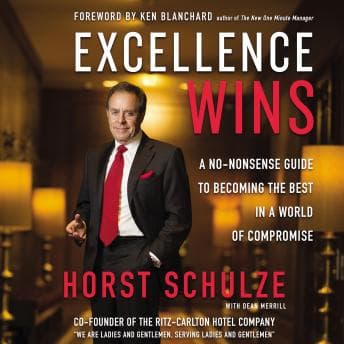

How many business books have you listened to that could've been a LinkedIn post? Because honestly, that's my default expectation at this point. Five hours of my life for maybe 20 minutes of actual insight. But Horst Schulze's Excellence Wins? This one actually earned its runtime.
I spent eight years at McKinsey watching companies pay lip service to "customer excellence" while treating their frontline employees like replaceable parts. Then I'd go home to Koreatown and watch my parents run their dry cleaning shop with more genuine service philosophy than any Fortune 500 I'd consulted for. They didn't have a vision statement. They just knew Mrs. Kim's blouses needed extra starch and Mr. Hernandez always picked up on Thursdays. That's excellence. That's what Schulze gets.
The Ritz-Carlton Guy Who Actually Gets It
Schulze built the Ritz-Carlton into a multibillion-dollar brand, and the refreshing thing is he doesn't make it sound like magic. It's systems. It's hiring right. It's treating employees like humans who can think. Revolutionary stuff, apparently, because most companies still haven't figured this out.
The key takeaway is worth the listen. The other 4 hours? Actually... also pretty solid. I was surprised. Schulze talks about servant leadership in a way that doesn't make me want to throw my phone out the car window. He's not peddling some feel-good nonsense—he's explaining why treating your team well is literally the most profitable thing you can do. I've seen this fail at three different companies where executives talked about "empowerment" while micromanaging every decision. Lean In touches on corporate empowerment theater too, though Sandberg's focus on individual navigation feels less useful than Schulze's systems-level fix. Schulze actually lived it.
His framework for employee orientation alone is worth the Audible credit. Most companies spend two days teaching people where the bathroom is and call it onboarding. Schulze spent 21 days making sure every single Ritz-Carlton employee understood they were responsible for guest satisfaction. Not their manager. Them. This is what my parents did instinctively. Now it has a TED talk.
Michael Wagner Does the Job
The narration is... fine? Good, actually. Michael Wagner has this clean, professional delivery that matches Schulze's no-nonsense approach. He's not trying to be dramatic. He's not doing voices. He's just delivering the content clearly, which is exactly what a business book needs.
I couldn't find much about Wagner's other work online, but based on this performance, the guy knows how to pace business content. No weird pauses. No over-emphasis on obvious points. Just steady, clear delivery that let me focus on the ideas instead of the performance. At 2.0x speed, everything still tracked perfectly. That's the real test for a business audiobook narrator.
Where It Actually Delivers
Here's what I appreciated—Schulze doesn't pretend excellence is easy. He talks about the discipline required. The daily reinforcement. The fact that most people will compromise because excellence is exhausting. Finally, a business book that respects your time by being honest about the work involved.
The faith element woven throughout might not be for everyone. Schulze is clearly a man of conviction, and he doesn't hide that. But it never felt preachy to me—more like context for why he approaches leadership the way he does. Jenny would say I'm being harsh on most business books. Jenny is right. But this one I'm actually recommending to clients.
The hospitality focus is specific, but the principles translate. I've already pulled three frameworks from this for a startup I'm advising—their customer service is a disaster, and Schulze's approach to defining service standards actually gave me something concrete to work with.
Who Gets Value Here (And Who Won't)
If you're in any kind of service business—and let's be honest, almost everyone is now—this belongs in your rotation. Founders, ops people, anyone building customer-facing teams. Skip it if you need tactical scripts or if faith-informed leadership rubs you wrong. Also skip to chapter 5 if you're already solid on vision statements. Thank me later.
The ROI Calculation
My parents never read business books. They were too busy working. But everything Schulze preaches? They were doing it in a 900-square-foot shop in Koreatown thirty years ago. The difference is Schulze scaled it to a global brand. That's the value here—taking instinctive excellence and making it teachable, repeatable, systematic.
Worth the listen. Actually worth the listen. (And yes, I'm as surprised as you are.)