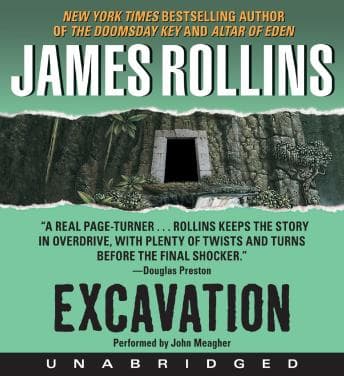

James Rollins writes the kind of books that people who've never read James Rollins think they're too smart for. And those people are wrong.
I say this as someone who spent the better part of a decade dismissing adventure thrillers as "not my genre." Horror snob? Guilty. But here's the thing — when you strip away the genre labels and just look at what Excavation is doing on a mechanical level, Rollins is pulling off something that a lot of literary horror authors can't: he never lets you breathe. Not once in twelve and a half hours.
Indiana Jones Meets Body Horror in the Andes
The setup is deceptively simple — archaeological dig in Peru uncovers something ancient and deeply wrong. You've heard this before. I've heard this before. But where Rollins diverges from the expected template is in the specificity of the wrongness. This isn't a vague curse or a shadowy presence. The threat has biological teeth. There's a sequence involving a substance that transforms living tissue — not in a campy B-movie way, but in a way that made me pause my audiobook and just sit in the dark of my apartment staring at the ceiling for a minute. Shirley (my cat) was unimpressed. I was deeply unsettled.
Rollins blends hard science (or at least science-adjacent speculation) with Incan mythology in a way that reminded me of Michael Crichton at his most unhinged. Think Congo meets The Ruins, but with more explosive set pieces and a willingness to get genuinely weird. The underground sequences — and there are many — have a claustrophobic energy that plays beautifully in audio. You're sealed in with these characters. No escape. The book understands that horror isn't always about gore — sometimes it's about being trapped somewhere ancient that doesn't want you there.
Is it literary? No. Does it need to be? Absolutely not. It knows exactly what it is, and it commits. I've been thinking about that kind of genre commitment a lot lately — Fallen Angels is another one that owns its darkness without apology, and there's something genuinely refreshing about books that don't hedge.
John Meagher Runs a Marathon at Sprint Pace
Here's where I have to be honest about what the narrator does and doesn't do. Meagher's performance is workmanlike in the best sense — he reads this thing like a metronome set to "relentless." The pacing is locked in from chapter one. No dips, no valleys, no moments where the energy sags and you start thinking about what you need at the grocery store. That consistency across twelve-plus hours is harder than it sounds. Most narrators flag somewhere around hour seven or eight. Meagher doesn't.
But — and this matters — he's not doing voices in a way that creates distinct personalities. The characters are differentiated more by context than by vocal signature. You know who's speaking because of what they're saying, not because Meagher gives them each a unique sonic identity. For a book with this many characters spread across multiple storylines (the dig team underground, the surface team dealing with political threats, the historical Incan timeline), that can occasionally create a "wait, who's talking?" moment. It's not a dealbreaker. But it does mean you need to be actively listening. This isn't a background-while-folding-laundry audiobook.
The narrator commits to the pace and never breaks stride. That's rare. I just wish he'd committed equally to the character work.
The Rollins Formula (And Why It Works Anyway)
Look, if you've read other Rollins — Subterranean, the Sigma Force series — you know the formula. Ancient mystery. Modern science. Characters who are competent but outmatched. Escalating reveals that stack like dominoes until the final act goes completely sideways. Excavation is early Rollins, and you can feel him still figuring out the balance between exposition dumps and action sequences. There are moments in the middle third where a character will essentially deliver a lecture on metallurgy or Incan history, and while the information is genuinely interesting, it slows the momentum that Meagher has worked so hard to maintain.
But then Rollins will throw something at you — a cave collapse, a betrayal, a biological transformation that has no business being as creepy as it is — and suddenly you're gripping your phone like it personally offended you. I was listening during a late shift at the library, headphones in while shelving returns in the back stacks, and I literally flinched at a scene involving a golden substance and what it does to human hands. In the quiet of a closed library, surrounded by shelves? That hit different.
The final act earns its chaos. Rollins doesn't just escalate — he pivots, and the last-hour reveal recontextualizes enough of the preceding story to feel genuinely earned rather than tacked on.
Who Needs This (And Who Should Keep Walking)
If you scare easily, this probably won't scare you — it's more dread-adjacent than outright horror. But if you want a thriller that borrows horror's best tricks (claustrophobia, body transformation, the violation of sacred spaces), this delivers. Crichton fans, The Descent fans, people who wish adventure fiction would occasionally get genuinely dark — this is your book.
If you need deep character psychology or literary prose, keep walking. Rollins is a plot engine, and characters exist to serve that engine. That's not a flaw. It's a choice.
I listened in the dark. Mistake? Maybe. Worth it? Absolutely. My podcast listeners are going to hear about this one — not as horror exactly, but as proof that adventure fiction can make your skin crawl when it wants to.