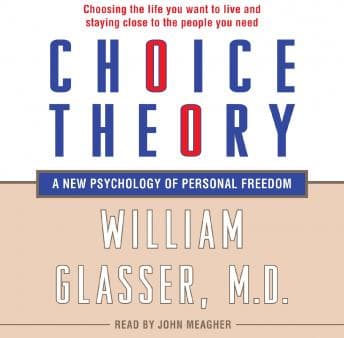

I was sitting in my home office at 11 PM last Tuesday, staring at a client's org chart that looked like a diagram of dysfunction. Two co-founders who couldn't stand each other, a VP of Engineering who'd basically seceded from the company, and a head of sales who communicated exclusively through passive-aggressive Slack messages. I needed something - anything - that might give me a new angle on why smart people destroy their own companies through bad relationships. So I fired up Choice Theory.
Bottom line: Glasser's central idea is genuinely powerful, and it's one I've watched play out across every failing startup I've ever consulted for. But he takes 12 hours to deliver what could've been a tight 4. Even at 2.0x, I felt the padding.
Your Parents Already Knew This (Mine Did Too)
Here's the core of Choice Theory in a sentence: You cannot control other people. You can only control yourself. Everything you do is a choice, and all long-term psychological problems are relationship problems.
I know. You're thinking "that's it?" But Glasser builds this into a surprisingly complete framework. He identifies what he calls "external control psychology" - the belief that you can make other people do what you want through reward, punishment, or guilt. And he argues that basically every unhappy marriage, every toxic workplace, every broken parent-child relationship runs on this operating system.
This is what my parents did instinctively. Now it has a TED talk.
My mom and dad ran that dry cleaning shop for 30 years. They never read Glasser. But my mom had this phrase she'd say in Korean - roughly, "I can only fold the shirts in front of me." She wasn't being philosophical. She was being practical. You deal with what you can control. You stop trying to force the world to cooperate. Glasser essentially wrote 300 pages proving my mom right. The same instinct — that self-determination is the only lever you actually own — runs through older texts too, including the early 20th-century Thought Vibration, or The Law of Attraction in the Thought World, though Glasser arrives at a far more grounded and honest destination than that tradition ever did.
What makes the book genuinely useful are the therapy session vignettes. Glasser walks through actual conversations with patients - a wife threatening divorce, a teenager refusing school, a man convinced his boss is ruining his life. In each case, he shows how the patient is choosing their misery (his words, not mine) by trying to control someone else's behavior. The shift from "my husband makes me angry" to "I am choosing anger as my response to my husband" is uncomfortable. It's supposed to be.
Where the Framework Cracks Under Pressure
Here's where I push back, and where my consulting experience actually matters. I've seen this fail at three different companies - the idea that all problems are relationship problems and all solutions are internal.
Glasser basically dismisses medication for mental health issues. He argues depression is a verb - "depressing" - something you choose to do. In 1998 when this was published, that was already controversial. Today it reads as borderline irresponsible. He's not entirely wrong that over-medicating is a problem, but his blanket rejection of biological factors feels like ideology, not science.
The other issue: he applies Choice Theory to situations where power dynamics make "choice" a loaded word. Telling a woman in an abusive relationship that she's "choosing" to stay - even if technically true in some philosophical sense - misses so much context that it becomes almost cruel. Glasser is clearly well-intentioned, but his framework doesn't account well for systemic constraints. My parents "chose" to work 14-hour days the way someone "chooses" to breathe.
The book also gets repetitive. By hour 8, I'd heard the same core concepts repackaged through different case studies at least four times. Skip to chapter 5. Thank me later. That's where Glasser gets into the practical application for marriages, and it's the most actionable section by far.
John Meagher Earns His Keep
Meagher's narration is clean and warm without being syrupy. For a 12-hour psychology book, that's not nothing. He maintains a conversational pace that kept me from zoning out during the more theoretical stretches - and there are stretches. His read on the therapy vignettes is where he really works: he shifts tone just enough between Glasser's voice and the patients' voices that you can track the conversation without getting lost. No dramatic character acting, just subtle shifts in warmth and tension. For this material, that's exactly right.
Clean production too. No audio artifacts, no weird edits. At 1.75x (yes, I dialed back from 2.0x for once - the concepts needed a beat to land), it flowed well.
Who Gets ROI Here
If you manage people - teams, clients, teenagers, a spouse who loads the dishwasher wrong - the core framework is worth absorbing. Managers and founders especially: I can't tell you how many leadership problems I've diagnosed that boil down to "you're trying to control people who don't want to be controlled." Glasser gives you language for that.
But if you're looking for peer-reviewed rigor or anything approaching modern neuroscience, look elsewhere. This is a practitioner's book, built on decades of clinical work, not controlled studies. It's philosophy dressed as psychology, and if you're okay with that, the insights land.
Jenny would say I'm being harsh. Jenny is right. But also - the key takeaway is worth the listen. The other 7 hours? Not so much.
The Billing Rate on This One
I went back to that client's org chart after finishing. And I realized every single conflict mapped to Glasser's framework: people trying to control other people's behavior instead of adjusting their own. Did the book give me a magic fix? No. But it gave me better questions to ask. For a business book - or a psychology book pretending to be a business book - that's a win. Just wish it didn't take 12 hours to get there.