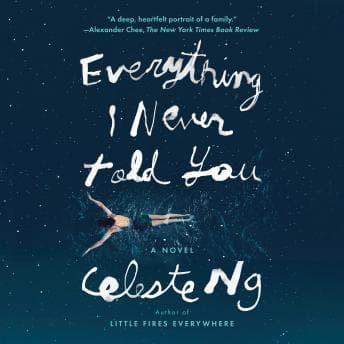

Can we talk about how emotionally manipulative this book is? And I mean that as a compliment. Celeste Ng opens with "Lydia is dead. But they don't know this yet," and then proceeds to spend the next ten hours systematically dismantling your heart while you're just trying to get through your morning commute. I finished this audiobook looking like I'd been through something, and honestly? I had been.
Here's the thing about Everything I Never Told You that caught me off guard: it's marketed as a mystery, and sure, there's a dead girl and a lake and questions about what happened. But the real mystery isn't about Lydia's death at all. It's about how an entire family can live under the same roof, share meals, celebrate birthdays, and still remain complete strangers to each other. That's the gut-punch Ng is really delivering, and Cassandra Campbell makes sure you feel every single blow.
On Cassandra Campbell's Voice
Campbell's narration is something I need to address because listener opinions are genuinely split. Her style is warm, steady, and measured—which works beautifully for the novel's literary pacing and the way it slips between past and present like memory itself. She captures the quiet devastation of the Lee family without resorting to melodrama, and her character differentiation is subtle but effective. You always know who's speaking, who's hurting, who's pretending not to hurt. That said, some listeners found her delivery of Marilyn—the mother whose unfulfilled ambitions become a weight her children carry—to be grating. I didn't have that experience, but I understand the criticism. Marilyn is an abrasive character by design, and Campbell doesn't soften her edges.
The more significant critique, and one I think deserves acknowledgment, is the missed opportunity of not casting an Asian or Asian American narrator for a story so deeply rooted in the Chinese American experience. James Lee's navigation of racism in 1970s Ohio, his desperate desire to belong, his children's struggle with their mixed-race identity—these are central to the novel's emotional architecture. Campbell handles these themes with care and without resorting to stereotypes, but there's an authenticity that a different casting choice might have brought. It's worth considering, even as Campbell's technical performance remains excellent.
A Family of Strangers Under One Roof
What Ng does extraordinarily well, and what the audiobook format amplifies, is the way she excavates the private lives of each family member. James, the Chinese American professor who spent his childhood wanting to be invisible. Marilyn, the white woman who abandoned her dreams of becoming a doctor and now lives vicariously through her daughter. Nath, the overlooked son who knows he's second-best. Hannah, the youngest, practically invisible to her own parents. And Lydia, the favorite, crushed under the weight of expectations she never asked for and couldn't possibly meet.
The pacing is deliberately slow—this is not a thriller, despite what the premise might suggest. It's a character study dressed in mystery's clothing. Campbell's steady delivery matches this perfectly, giving you time to sit with each revelation, each small cruelty, each moment of misunderstanding that compounds into tragedy. I listened at 1.0x speed, which felt right for this material. Speeding it up would feel like rushing through grief.
I found myself listening during evening walks rather than my usual workout rotation. This isn't a book for the gym. It's too quiet, too introspective, too likely to make you stop mid-rep and stare at nothing while processing what you just heard. It's perfect for those moments when you want to feel something real, when you're in the mood to be wrecked by beautiful prose and painful truths about family, love, and all the things we never say to the people who matter most.
The production quality is clean and professional—no audio issues, no distracting background noise, just Campbell's voice carrying you through the Lee family's unraveling. For a novel this emotionally heavy, that technical polish matters. You don't want anything pulling you out of the story.
Ng's writing is precise in a way that almost hurts. She doesn't waste words. Every sentence does work, building toward an understanding of how good intentions can become prisons, how love can become pressure, how silence can become the loudest thing in a room. Campbell translates this to audio with skill, letting the prose breathe without over-performing.
Who This Is (and Isn't) For
This audiobook isn't for everyone. If you're looking for resolution, for catharsis, for a mystery that wraps up neatly—look elsewhere. If you need something light to get you through a rough week, this will only make it rougher. But if you want a story that will make you think about your own family, your own silences, the things you've never told the people you love? This is the one. Apples Never Fall does something similar with family secrets, though it trades quiet devastation for propulsive mystery. Have tissues ready. You've been warned.