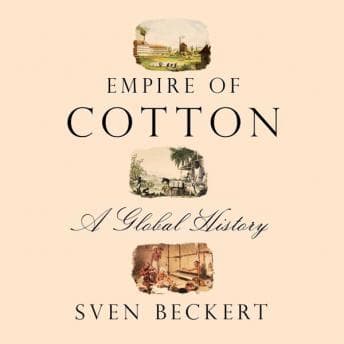

What if the most boring-sounding commodity on the planet — a white, fluffy plant fiber — turned out to be the engine that built modern capitalism, fueled slavery, triggered wars, and reshaped every continent on Earth?
That's the question Sven Beckert drops on you in the first hour of Empire of Cotton, and then he spends the next nineteen hours methodically proving his case. I finished this one on a long drive back from a client site in Houston, and somewhere around Bastrop, I caught myself gripping the steering wheel like I was reading an after-action report on the fall of the Confederacy's cotton economy. Which, in a way, I was.
The Commodity That Built — and Broke — the World
Let me cut to the chase: this is a serious academic history that reads more like a global intelligence briefing than a textbook. Beckert traces cotton from its pre-industrial origins in India and the Islamic world through the British Empire's weaponization of it, American slavery's absolute dependency on it, and its eventual migration to Egypt, Brazil, and colonial Africa. The scope is staggering. You'll learn how Liverpool merchants in the 1790s built financial instruments around cotton futures that wouldn't look out of place on a modern trading floor. You'll hear how the East India Company systematically dismantled India's centuries-old cotton manufacturing to turn the subcontinent into a raw material supplier for Lancashire mills.
What hit me hardest — and I've seen this scenario play out in different forms across my career — is how Beckert connects military force to economic dominance. He doesn't just say "imperialism was bad." He shows you the mechanics. British gunboats protecting shipping lanes. That same forensic approach to how military force and economic ambition operate as a single machine reminded me of what Dennis Showalter does in Armor and Blood: The Battle of Kursk — though Beckert is working on a much longer timeline, the logic of state violence serving industrial interests cuts through both books with the same cold clarity. American plantation owners lobbying for territorial expansion. German industrialists pushing Bismarck toward African colonization specifically to secure cotton-growing land. The author clearly did their homework, and it shows in every chapter. This isn't polemic; it's forensic.
The concept Beckert keeps returning to is what he calls "war capitalism" — the idea that before factory capitalism could exist, you needed state-sponsored violence to seize land, enslave labor, and destroy competing producers. It's an uncomfortable argument, and he builds it brick by brick with trade ledgers, parliamentary records, and correspondence from merchants who discussed human beings with the same language they used for bales of raw fiber.
Frangione vs. Twenty Hours of Spindle Counts
Jim Frangione has a thankless job here. He's narrating a book that alternates between genuinely gripping economic history and passages that compare spindle counts between Manchester, Osaka, and Bombay circa 1870. And look — he handles the readable sections well. His delivery is clear, professional, measured. When Beckert is describing the Haitian Revolution's impact on global cotton markets or the desperation of Confederate diplomats trying to leverage cotton as a geopolitical weapon, Frangione keeps you locked in.
But when the book shifts into its more data-heavy stretches — and there are several — Frangione can't inject drama where the text doesn't provide it. Nobody could. When you're listening to comparative analysis of Indian versus Egyptian staple-length fiber yields at 1.25x on I-10, there's a limit to what any narrator can do. I wouldn't hold it against him. He's steady, he's clear, and he makes business concepts land without dumbing them down. That's enough for material this dense.
This Is Where It Lost Me — Briefly
Around the 14-hour mark, the book enters a stretch covering late 19th-century cotton industrialization across multiple continents simultaneously. Beckert is doing important comparative work — showing how Japan, Russia, Brazil, and colonial Africa all entered cotton manufacturing under wildly different conditions — but it starts to feel like you're reading five parallel dissertations at once. I had to rewind a couple of sections because my attention drifted during a particularly granular comparison of labor conditions in Bombay mills versus those in the American South.
But here's the thing: even those sections pay off. By the time Beckert reaches the 20th century, you understand why cotton manufacturing moved from Britain to the Global South, why that shift created the economic patterns we still live with, and why a t-shirt from Bangladesh carries centuries of violent history in its fibers. The payoff is worth the grind.
Who Should Ruck Up for This One
If you're interested in how global economics actually works — not the sanitized version, but the blood-and-soil mechanics of how capital accumulates — this is essential listening. Military history buffs will find unexpected depth here too, because Beckert shows how every major conflict from the Civil War to colonialism in Africa was shaped by cotton economics. But if you need action beats every twenty minutes to stay engaged, this isn't your book. It's a 20-hour academic history. Know what you're signing up for.
Worth your time? Here's the debrief: Empire of Cotton is one of those books that permanently changes how you see the world. Every time I put on a cotton shirt now, I think about the centuries of exploitation woven into it. That's the mark of a book that does its job. Ranger slept through the spindle count sections, but he perked up during the Civil War chapters. Smart dog.
Mission accomplished — with some long stretches in the field.







![Steve Jobs [unabridged audiobook] audiobook cover](/_next/image?url=https%3A%2F%2Fcovers.audiobooks.com%2Fimages%2Fcovers%2Ffull%2F9788499923406.jpg&w=1920&q=75)