
"Our emotions have a mind of their own, one which can hold views quite independently of our rational mind."
That line hit me somewhere around the 45-minute mark, wedged between two strangers on the 6:47 Caltrain, running on four hours of sleep after yet another pager storm. And I thought: yeah, that tracks. My rational mind knows I should be calm during a P0 incident. My amygdala has other plans.
The Irony You Can't Unhear
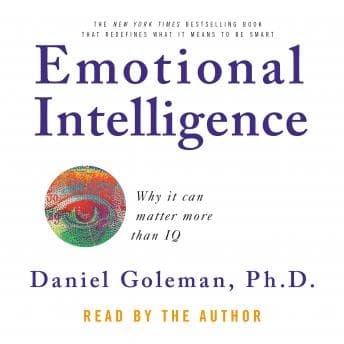
Let's get the elephant out of the room. Daniel Goleman wrote the foundational book on emotional intelligence - the ability to recognize, understand, and manage emotions in yourself and others. He then narrated the audiobook version with all the emotional range of a System.out.println() statement.
I'm not exaggerating. The man reads his own groundbreaking work in a flat, monotone cadence that could double as a sleep timer. There's a section where he describes a father's rage spiraling into violence against his stepdaughter, and Goleman delivers it with the same affect as reading a grocery list. It's... jarring. You're absorbing genuinely disturbing case studies about emotional hijacking and trauma, and the narration is giving you nothing. Zero inflection. It's like listening to documentation being read aloud by someone who's been awake for 36 hours.
The cruel irony writes itself. I won't belabor it.
The Content Is a Different Story (Literally)
Here's the thing though - the actual material? Still holds up remarkably well for a book published in the mid-90s. Goleman's framework for breaking down emotional intelligence into five components (self-awareness, self-regulation, motivation, empathy, social skills) is basically the API spec that every subsequent EQ book has been building on. If you've read any modern leadership or psychology book that talks about emotional intelligence, you've been reading Goleman's descendants. The same lineage shows up in unexpected places - I kept thinking about the behavioral frameworks in Machine Learning: The New AI, which maps how systems learn to pattern-match inputs in ways that rhyme uncomfortably well with how Goleman describes emotional conditioning.
The neuroscience sections are where this shines. His explanation of the amygdala hijack - how your emotional brain can essentially short-circuit your prefrontal cortex and trigger a fight-or-flight response before your rational mind even processes what's happening - that's genuinely useful mental model stuff. I think about it now when I'm in a heated code review. (Is this a rational response to a bad PR, or is my amygdala hijacking me because someone touched my service?) The research on how childhood emotional learning physically sculpts neural pathways is fascinating and a little terrifying.
But at 3 hours 40 minutes, this is clearly an abridged version of the full book, and you can feel the compression. Some sections rush through studies that deserve more space, while others linger on points that feel repetitive. The childhood development chapters get the most depth; the workplace application stuff feels like it got trimmed to a highlight reel.
Could've Been a Blog Post? Almost the Opposite Problem.
Usually with business/self-help audiobooks, I'm cranking to 1.75x because the author took one TED talk and stretched it into 8 hours. Goleman has the opposite issue - there's genuinely too much research crammed into too short a runtime, and the monotone narration makes it hard to distinguish when he's shifting between major concepts. I actually had to drop to 1.25x because at my usual 1.5x, Goleman's flat delivery turned into an undifferentiated stream of psychology terms and I'd zone out, miss a transition, and suddenly we're talking about childhood depression when I thought we were still on workplace performance.
The ROI on this audiobook is complicated. The ideas? High ROI. This is genuinely one of those books where the core framework changes how you think about human interaction. The audio format specifically? Low ROI. You're fighting the narration the entire time.
Who This Is (and Isn't) For
If you've never read the book and want the concepts, honestly? Read the physical copy or find a good summary. The audiobook version makes you work too hard against the narration to absorb dense material.
If you already know the framework and want a refresher, the short runtime is actually nice - three commutes and done. Just know you'll need to be more awake than I was.
Skip this if you need engaging narration to stay focused (so, like, everyone on public transit at 6AM). This is not a background listen. This is not a gym listen. This requires dedicated focus, which is a lot to ask when the narrator is actively working against your attention span.
The Commit Message
I respect what this book did for the field. Goleman basically gave the world a vocabulary for something we all intuited but couldn't articulate - that being smart about feelings matters as much as being smart about algorithms. The science actually holds up, even decades later.
But the audiobook experience? It's like a brilliant engineer giving a keynote with no slides, no vocal variety, and the lights turned low. The content deserves better delivery. I finished it, I'm glad I know the material, and I will never listen to it again. Get the print version.