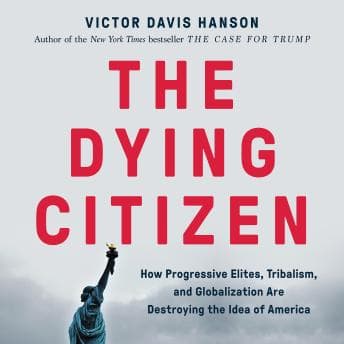

When's the last time you actually thought about what it means to be a citizen? Not a resident, not a consumer, not a demographic category on a survey — a citizen? That question kept rattling around my head during a late-night session with this one, sitting on my back porch in Austin while Ranger dozed at my feet and the neighborhood was dead quiet. Felt like the right setting for a book that's essentially a 15-hour warning siren.
Let me cut to the chase: Hanson wrote a serious, heavily footnoted argument that American citizenship is being hollowed out from multiple directions simultaneously. And whether you agree with his politics or not, the historical framework he builds is substantial.
A Classicist With a Chainsaw
What separates Hanson from the average political commentator is his background. The man is a classicist and military historian, and he doesn't let you forget it. He draws lines from ancient Greece and Rome straight through to modern America — the erosion of the middle class, the concentration of power in unelected bureaucracies, the fracturing of shared identity. Some of these parallels land hard. His analysis of how Athenian citizenship degraded when the distinction between citizen and non-citizen became meaningless? That's not some talk-radio rant. That's a historian doing what historians do.
But here's where it gets interesting — and where some listeners will check out. Hanson is unambiguously conservative, and he's not trying to hide it behind academic neutrality. His chapters on immigration and identity politics don't pull punches. He treats open borders and tribal identity as existential threats to the citizenship concept, backing it with data but also with a clear ideological lens. If you're expecting a balanced, both-sides-of-the-aisle treatment, wrong book. If you want a rigorous argument from one particular foxhole, the author clearly did their homework.
The section on the administrative state — the unelected fourth branch of government, as Hanson frames it — is probably the strongest part of the book. He walks through how federal agencies have accumulated legislative, judicial, and executive power that the Founders never intended. I've seen this scenario play out in real life through my consulting work. Try navigating federal compliance regulations for a small firm sometime. You'll feel Hanson's frustration in your bones.
James Edward Thomas Gets the Job Done
Thomas narrates with a clean, measured delivery that matches the academic weight of the material. No dramatic flourishes, no vocal fireworks — just steady, professional reading that lets Hanson's arguments carry themselves. For a 15-hour political nonfiction book, that's exactly what you want. I bumped it to 1.25x and it held together perfectly at that speed. His enunciation is crisp enough that even the dense historical passages — and there are plenty — never turn into mush.
Here's what I'll say: Thomas doesn't bring a lot of personality to the table. He's a vehicle for the text, which works, but after 15 hours you might wish for a narrator who could inject some of Hanson's dry wit into the delivery. Hanson's writing has moments of sharp, almost sardonic humor — particularly when he's dissecting political hypocrisy — and Thomas reads them the same way he reads the data-heavy sections. Not a dealbreaker, but a missed opportunity.
Where the Perimeter Gets Thin
This is where it lost me in spots: the book is long, and some chapters feel like they're relitigating arguments Hanson has already won two chapters ago. The immigration section in particular could've been tighter — he makes his central point early, then keeps reinforcing it with variations that start to blur together around hour 10. At 15 hours, there's maybe 11 hours of unique argumentation. A tighter edit would've made a stronger case.
And look — Hanson's framing of 2020 as a civilizational inflection point is dramatic. Sometimes effectively so. But occasionally it tips into a tone that feels more like an op-ed than a history book, and those moments undercut the scholarly rigor he otherwise maintains. When he sticks to classical parallels and constitutional analysis, he's at his best. When he drifts into current-event commentary, the shelf life shortens.
Who Should Ruck Up For This
If you're a history and civics junkie who leans conservative — or if you're willing to engage seriously with conservative arguments even if you don't share them — this is worth your time. The historical depth alone sets it apart from most political books. If you're easily irritated by right-of-center analysis, save your blood pressure.
Worth your time? Here's the debrief: Hanson delivers a densely argued, historically grounded case that's about 20% too long but 80% genuinely sharp. Thomas keeps the audio clean and professional. Not a book that'll change anyone's mind, but it'll sharpen whatever mind you've already got. I had a similar reaction to This Will Not Pass — different ideological foxhole entirely, but the same feeling of watching serious people argue seriously about whether the republic holds.
Ranger slept through most of it. But he perked up during the administrative state chapters. Smart dog.




![Steve Jobs [unabridged audiobook] audiobook cover](/_next/image?url=https%3A%2F%2Fcovers.audiobooks.com%2Fimages%2Fcovers%2Ffull%2F9788499923406.jpg&w=1920&q=75)