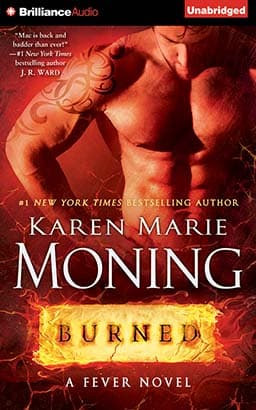

There's a moment right at the start—Mac is lying on a cold stone floor, completely stripped (literally and emotionally), dealing with a magical addiction that makes zero sense to my logical brain but somehow works in this chaotic universe Moning built. I was listening to this part while my train was stalled outside San Bruno, surrounded by tired tech workers, and I honestly had to check if my headphones were leaking sound. It felt... intrusive.
(Kevin would hate this. He needs hard magic systems with defined rules. This is pure chaos. But sometimes you just need to watch the system crash.)
The Narrator Switch: Feature or Bug?
Look, we need to talk about the elephant in the server room. If you've binged the first three books (which, let's be real, you have if you're here), you're used to Joyce Bean. She was the legacy code for Mac's voice.
Suddenly, we get a patch update: Natalie Ross and Phil Gigante.
Does it work? Mostly. It's a dual narration setup, which usually I love for efficiency—it separates the male and female dialogue threads cleanly. Phil Gigante? The guy has a voice like a well-shielded subwoofer. He handles Barrons and V'lane with the kind of gravitas that makes you understand why Mac is making terrible life choices.
But Natalie Ross... it's complicated. Her Irish accent fluctuates like my Wi-Fi signal in the tunnel. Sometimes it's there, sometimes she sounds like she's from the Midwest. If you're an audio purist, this might bug you. It took me about three chapters (roughly the distance from Millbrae to San Mateo) to stop twitching every time the accent slipped. Once I adjusted my parameters, though, her emotional delivery actually hits harder in the darker scenes.
System Failure: Mac's Descent
This isn't the "spunky girl solves crimes" vibe of the earlier books. This is a full system failure for the protagonist. Moning strips away Mac's defenses—her vanity, her optimism, her autonomy.
It's brutal. And honestly? It's effective.
The "Pri-ya" situation (basically a magical rootkit exploit that overrides Mac's self-control) is uncomfortable to listen to, especially on a crowded commute. But it raises the stakes. We aren't just debugging a mystery anymore; we're fighting for admin access to Mac's own mind. The pacing is relentless. I cranked this to 1.75x because I physically couldn't wait to see if she'd stabilize.
The Barrons vs. V'lane Optimization Problem
Okay, so we have two variables here. Barrons is the proprietary software—closed source, reliable, dangerous, refuses to explain how he works. V'lane is the flashy open-source UI—looks pretty, seems helpful, but might have malware embedded in the kernel.
That same "trust no one" paranoia runs through Third Kingdom, though with less sexual tension and more actual swords.
With the dual narration, the contrast between them is way sharper. Gigante gives them distinct frequencies. The tension between the three of them is the only thing keeping the plot moving during the middle section, which admittedly drags a bit (could've been a few JIRA tickets shorter).
Who's This Build For?
Listen if you've already committed to the Fever series and can handle dark content on your commute. Skip if you're like Kevin and need your magic systems documented with clear API specs—this one runs on pure chaos energy. Also maybe skip if inconsistent accents are a dealbreaker for you.
Closing the Ticket at 2 AM
I finished this on a Tuesday when I should have been sleeping before a sprint review. The ending? It's a cliffhanger that violates every safety protocol. You will be angry. You will immediately download the next book.
Just... maybe don't listen to the first two chapters at the gym. Trust me on this.