
This is not my usual lane. Let me just get that out there.
I'm a distributed-systems engineer who listens to hard sci-fi and productivity books. My prayer life consists mostly of whispering "please don't page me" before bed. But Kevin's mom gave us both a copy of this for Christmas — his physical, mine on Audible — and she asks about it every Sunday FaceTime call. So here we are.
And honestly? I'm glad she pushed.
A Devotional That Actually Has a Runtime Strategy
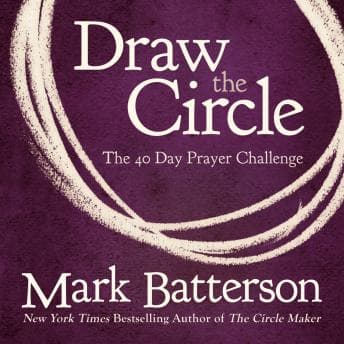
Draw the Circle is structured as 40 short daily devotionals, each maybe 8-10 minutes of audio. That's a design decision I can respect as an engineer. Batterson isn't asking you to sit down for a two-hour theology lecture. He's asking for a daily sprint. The whole thing clocks in at 6 hours 12 minutes, which means you could technically binge it in three commutes like I almost did — but that defeats the purpose. The ROI on this audiobook is highest when you actually space it out, one chapter per day, which is a weird thing for me to recommend because I'm the person who finishes trilogies in a weekend.
The structure works like this: each day opens with a scripture, moves into a true story (either Batterson's own or from readers of The Circle Maker), and closes with a prayer prompt. It's formulaic in the way that a well-designed API is formulaic — predictable interface, variable content. You know what you're getting, but the stories inside each day keep it from feeling copy-pasted.
Day 4 hit me unexpectedly hard. Batterson tells the story of John and Tricia and their son Eli — a real family, a real crisis — and the way he reads it, you can hear his voice tighten just slightly at the pivot point. It's not theatrical. It's pastoral. That distinction matters.
Author-Narrated: The Feature and the Bug
Batterson narrates his own book, which for a devotional like this is the right call. He's a pastor, and he sounds like one — warm, measured, the kind of voice that knows when to slow down. He's not Ray Porter (obviously, no one is), and he's not going to win any Audie awards for vocal range. But he's reading his own prayers, his own convictions, and there's an intimacy to that which a professional narrator couldn't replicate. When he says "I believe God is going to show up," it doesn't sound like a line reading. It sounds like a guy who actually believes it.
The downside? His pacing is pretty uniform. There's no dynamic shift between the storytelling sections and the prayer prompts — it all flows at the same pastoral tempo. At 1.5x it's fine. I wouldn't go higher than that because some of the prayer moments genuinely benefit from breathing room, and at 1.75x you lose the pauses that make them land.
The "Could've Been a Blog Post" Test
Here's where I have to be honest. Some days feel thin. A few of the devotionals are essentially "pray boldly + here's a verse + here's a one-paragraph anecdote." If this were a business book, I'd slap the blog-post label on it without hesitation. But devotionals play by different rules. The point isn't information density — it's repetition and rhythm. You're not trying to learn a new framework. You're trying to build a habit. And for that, the short-and-consistent format actually works.
What keeps it from being generic is the specificity of the testimonies. These aren't abstract "someone somewhere prayed and good things happened" stories. They're named people with named situations, and Batterson connects them back to concrete prayer principles from The Circle Maker. I haven't read (or listened to) The Circle Maker, and I could still follow everything, but I got the sense I was missing some context — like joining a sequel's Slack channel without reading the original PRD.
Who This Is (and Isn't) For
Perfect for: morning routines, wind-down before bed, anyone trying to build a structured prayer practice. If you're already in the Christian faith space and want something that's practical rather than academic, this delivers.
Skip for: anyone looking for theological depth or apologetics. This is devotional, not seminary. Also skip if you need narrative momentum to stay engaged — the 40-day structure means there's no plot arc, no climax, no resolution. It's designed to be metabolized slowly.
And definitely skip if you're hoping for production fireworks. Single narrator, no music, no sound design. Clean audio, zero frills.
The Commit Message
I listened to most of this during the quiet 6:15 AM trains before the Millbrae crowd boards, one chapter a day queued up right after my morning alarm. It became a weird little ritual — earbuds in, eyes closed, eight minutes of something that isn't Jira tickets or incident reports. I'm not going to pretend it changed my life. But it changed my mornings for 40 days, and that's not nothing.
Kevin's mom will be pleased.