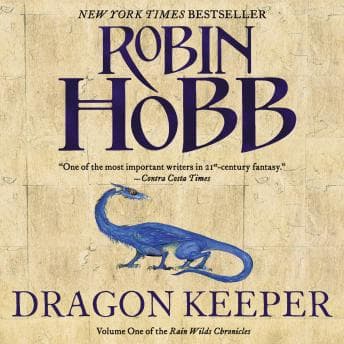
Look, I need to rant about something before we get into this. Robin Hobb wrote one novel — one beautiful, sprawling, character-driven novel about stunted dragons and their misfit keepers journeying upriver to find a legendary city — and her publisher split it in half. Dragon Keeper ended mid-breath. Dragon Haven picks up that same breath and exhales for nearly twenty hours. And I'm sitting here at 11PM on a Thursday, papers half-graded, listening to characters I've spent forty hours with now, and I'm annoyed. Not at Hobb. At the fact that this book made me care so much about fictional dragons that I gave Sedric's betrayal more emotional energy than I gave my sophomores' essays on The Great Gatsby.
That's the Hobb problem. She gets under your skin. I had a similar feeling with French Gardener — that slow, creeping realization that a book has quietly rearranged your priorities without asking permission.
The Slow River That Drowns You
Let me be honest about the pacing, because if you're coming from the Farseer books or even Liveship Traders, the Rain Wilds Chronicles move like the Rain Wild River itself — muddy, winding, occasionally threatening to swallow you whole. This is a middle-book in every sense. The expedition to find Kelsingra is still underway. Characters are still growing into themselves. Thymara is still figuring out who she is, which — as someone who watches sixteen-year-olds do this in real time five days a week — Hobb captures with painful accuracy. The way Thymara negotiates between what she wants and what she's been told she deserves? I've seen that exact internal war in my students. Hobb just puts scales on it.
But the flood sequence. When it hits, you understand why Hobb spent all those quiet hours building relationships between dragons and keepers. Because when the water rises and everything goes sideways, you're not just worried about plot survival — you're worried about specific bonds you've watched form. That's the payoff of patience.
And then there's Sedric sneaking out to drink dragon blood, which is the kind of grotesque, desperate, morally compromised decision that makes Hobb's characters feel real rather than heroic. This reminds me of what Hemingway said about writing — that the dignity of movement of an iceberg is due to only one-eighth of it being above water. Hobb's characters carry so much beneath the surface.
Anne Flosnik and the 1.0x Dilemma
Here's where I have to wrestle with my own principles. I'm a 1.0x listener. Always have been. The author chose those words, and the narrator sets the rhythm. But Anne Flosnik's narration tested that conviction more than once across these twenty hours.
She's not bad. Let me be clear about that. She has a solid British delivery and her pronunciation of Hobb's invented world — the Elderlings, the Rain Wilds, the whole ecosystem — is consistent and confident. She creates atmosphere when it matters. During the flood, her pacing tightens and you can feel the urgency without her overselling it. The narrator understands that pause is punctuation, and when she's locked into an emotional scene, her restraint actually serves Hobb's prose well.
But. There are stretches — long expository stretches, and Hobb has plenty — where the delivery flattens out. Not monotone exactly, but close enough that my attention drifted during a faculty meeting and I missed both the budget discussion AND a chapter transition. (Principal Martinez, I was definitely paying attention. I was not.) There are also some production hiccups — a repeated line here, an uneven pause there — that pulled me out. And I'll admit: a few of the character voices blur together. With a cast this large, differentiating between, say, the male keepers requires some mental effort that the narration doesn't always help with.
People recommend 1.25x speed for Flosnik and I understand why. But speeding up Robin Hobb feels wrong to me. The prose deserves to be savored. So I stayed at 1.0x and accepted the trade-off.
Who Gets on This Barge
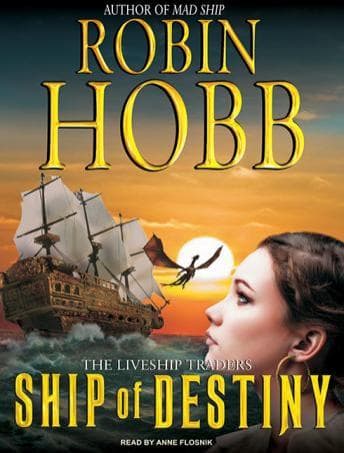
If you loved Liveship Traders, this is its spiritual successor — same world, same themes of identity and transformation, same willingness to let characters be messy and selfish and slowly, grudgingly become better. If you need action every chapter, this isn't your river. My students would hate this. I love it.
But fair warning: start with Dragon Keeper. Walking into Dragon Haven cold would be like starting Middlemarch at Book Four. You'd technically survive, but you'd miss the whole architecture.
And if Flosnik's style didn't work for you in Dragon Keeper, it won't suddenly click here. Same narrator, same approach, same production quality for better or worse.
Worth Pausing the Faculty Meeting For
Robin Hobb writes the kind of fantasy that literary fiction readers secretly love — character studies wearing dragon scales. Dragon Haven is the slower half of a story that needed both halves to work, and it rewards the patient listener with genuine emotional weight. The narration is uneven but functional. Not every performance needs to be theater — sometimes a steady hand on the tiller is enough to get you upriver. I'll be starting Blood of Dragons tomorrow.
Denise says I talk about these dragons like they're real. She's not wrong.