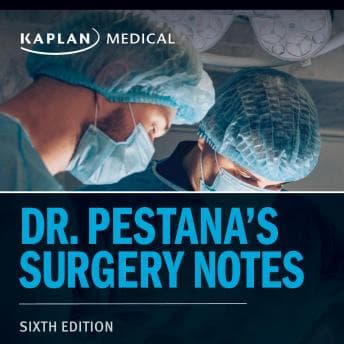

Look, I need to explain myself. I'm a software engineer. I don't have a surgical clerkship exam. I have never performed surgery on anything more complex than a segfault. So why did I spend nearly 6 hours listening to Dr. Pestana's Surgery Notes on audio?
Blame insomnia and a morbid curiosity that kicked in at 1AM after I rage-closed my laptop following a particularly soul-crushing Kubernetes debugging session. My Audible recommendations algorithm has apparently decided I'm a polymath, and honestly, I was too tired to argue with it.
Why Is a Software Engineer Reviewing a Surgery Textbook on Audio?
Fair question. Here's my honest answer: I'm fascinated by how other fields compress knowledge for high-stakes exams, and I listen to roughly a book every 5-6 days, so occasionally I wander outside my lane. Survival of the Sickest scratched a similar itch for me — medical knowledge delivered with the kind of "wait, why does this work" framing that makes you feel like you're in on a secret. This is basically Cracking the Coding Interview but for people who cut humans open instead of debugging them. And as someone who's consumed a LOT of educational audio content, I have opinions about what works and what doesn't in this format.
The book itself is a concentrated review guide - Carlos Pestana is an emeritus professor of surgery at UT San Antonio with a Mayo Clinic residency and actual involvement in designing USMLE Step 2 questions. So the man literally knows what's on the test because he helped write it. That's like getting interview prep from the hiring committee. The ROI on this audiobook is sky-high if you're the target audience.
But here's the thing that kept nagging me as I listened: this is a pocket-sized review that was designed to be read in quick bursts, with bullet points and clinical vignettes you'd flip through with a highlighter. Converting that to audio is... a choice.
The Audio Format Problem (Or: Some Books Aren't Meant to Be Heard)
Matthew Kugler narrates with a clean, professional tone. No complaints about clarity or pacing - the man reads medical terminology like he's been doing it his whole life. But here's where I got stuck: this content is fundamentally structured as reference material. It's organized by surgical topic - trauma, vascular, pediatric, hernias - and each section is a rapid-fire sequence of clinical scenarios and their management approaches.
On paper (or Kindle), you'd scan, highlight, and revisit specific sections. On audio, it's a 5-hour-44-minute stream of "patient presents with X, you do Y" that your brain has to somehow index without visual anchors. I found myself rewinding constantly, not because Kugler was unclear, but because the information density is so high that one wandering thought at a stoplight means you've missed the management of three different types of bowel obstruction.
I tried this at my usual 1.5x and had to drop to 1.25x within the first 20 minutes. At 1.5x, the clinical vignettes blur together like log entries during an incident - you need that extra beat to process.
Who This Actually Works For
Here's where it gets interesting. If you're a third-year med student who's already done the reading and needs passive reinforcement while commuting to your rotation - this is genuinely useful. It's the audio equivalent of flashcard review. Your brain goes "oh right, tension pneumothorax, needle decompression, I remember that" and the repetition locks it in. For that specific use case? Brilliant.
If you're coming in cold trying to learn surgery from audio alone? You're going to have a bad time. This isn't a narrative. There's no story arc to carry you. There's no Ray Porter making you forget you're learning something. It's pure information transfer, and the audio format fights against the content's natural structure.
And if you're a random software engineer listening at 1AM because you couldn't sleep - you'll learn just enough to be dangerous at dinner parties. I now know that the most common cause of small bowel obstruction is adhesions from previous surgery, and I will deploy this fact at exactly the wrong moment. Kevin's going to love it.
The Commute Calculus
TL;DR: Worth your commute only if you're studying for shelf exams or USMLE Step 2. For the target audience, this is an efficient reinforcement tool with clean narration. For everyone else, this is 5 hours and 44 minutes of highly specialized content that doesn't translate well to the passive listening experience.
Perfect for: focused study sessions, review during clinical rotations. Skip for: casual learning, anything requiring divided attention.
The production is no-frills - straight narration, no sound effects, no music, which is exactly right for this kind of material. Pestana's content has been celebrated by med students for over a decade for a reason: it's high-yield and ruthlessly efficient. But the audio format is a constraint here, not an enhancement. If you're the target audience and audio is your preferred study mode, go for it. But keep the physical copy too - you'll want to flip back.




![Steve Jobs [unabridged audiobook] audiobook cover](/_next/image?url=https%3A%2F%2Fcovers.audiobooks.com%2Fimages%2Fcovers%2Ffull%2F9788499923406.jpg&w=1920&q=75)