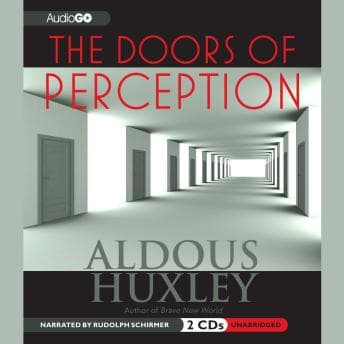

Ever wonder if the quarterly business review is actually the hallucination and the guy staring at a flower for four hours has it right? That's the question I was asking myself somewhere over the Midwest at 30,000 feet. I usually reserve flight time for catching up on market analysis or, if I'm feeling particularly masochistic, listening to another founder memoir about "hustle culture." But this time, I went with Huxley.
Two hours. That's it. In a world where business authors bloat a single blog post concept into a 12-hour audiobook to justify the hardcover price, Huxley's brevity is a godsend.
When Silicon Valley Meets 1953
Let's be real—psychedelics are the new golf in the startup world. I can't throw a rock in San Francisco without hitting a product manager who's microdosing to "optimize their flow state." It's exhausting.
What makes The Doors of Perception interesting—and frankly, way better than the modern tech-bro interpretation—is that Huxley isn't trying to be productive. He isn't trying to disrupt the taxi industry. He's just... looking at trousers.
Seriously. There is a solid chunk of this book where he is absolutely mesmerized by the folds in his flannel pants. And because it's Huxley, he makes it sound like a breakthrough in physics.
Unlike Michael Pollan's recent stuff (which is great, don't get me wrong, but very journalistic), Huxley writes like a philosopher who accidentally stumbled into a shaman's tent. If you want something from Huxley that's less about mescaline and more about social satire, Crome Yellow shows his sharp wit in a country house setting. It's dense. It's intellectual. It's not a "how-to" guide for your next retreat. It's a raw data dump of a very smart brain on a very strong chemical.
Schirmer's Clinical Delivery
Rudolph Schirmer. I couldn't find much on his background, but let me tell you—this guy sounds like he's reading a medical diagnosis. And for me? That worked.
Here's the thing: most narrators dealing with "trippy" content try too hard. They get all breathy. They do the "whoa, man" voice. Schirmer does none of that. He is clinically dry. He sounds like a tenured professor explaining the tax code, except the words coming out of his mouth are about the infinite vibration of color.
(Jenny listened to five minutes and said, "He sounds like he's bored." I told her he sounds like he's objective. We agreed to disagree.)
The contrast is the selling point. A dramatic actor reading this would feel like a bad B-movie. But having this dry, hybrid British-American voice articulate the dissolution of the ego gives it a weird credibility. It grounds the craziness. It makes you think, "Okay, maybe there is logic here," rather than just writing it off as a drug trip.
The ROI Calculation
Look, this isn't going to help you negotiate a better salary. It's not going to improve your KPIs. For actual productivity advice, something like No Excuses! is more on-brand for the hustle crowd. But as a study in shifting perspective? It's efficient.
At 2h 16m, it's basically a long podcast. I cranked it to 1.75x (Schirmer talks slow, trust me), and knocked it out before landing.
Who's this for: Curious executives who want to understand why Steve Jobs and half the Fortune 500 CEOs are obsessed with this stuff—this is the source code. Skip it if you need narrative momentum or actionable takeaways; it's a man sitting in a chair, staring at a chair, realizing he is the chair.
If you can handle the dryness, it's worth the credit. If you need excitement, go buy a thriller.