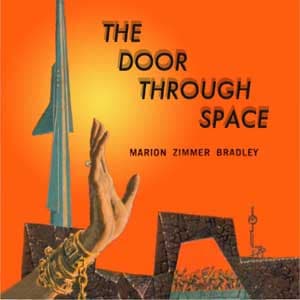

Marion Zimmer Bradley's Door Through Space is a 1961 pulp sci-fi novel that reads like someone's first draft of a Darkover book — because that's basically what it is.
I was deep into a 2 AM coding session, trying to get a procedural dungeon generator to stop producing rooms that overlapped like a bad Venn diagram, and I needed something short to keep me company. Under four hours? Sci-fi? Sure, throw it on. What I got was a Cold War-era space spy thriller wrapped in the trappings of a sword-and-planet adventure, and honestly, those two genres fight each other for the entire runtime like two characters who share confusingly similar names. (Which, by the way, is also a problem in this book.)
When Your Intelligence Agent Has the Self-Awareness of a Level 1 Fighter
Race Cargill — and yes, that is the protagonist's actual name — is a washed-up Terran Intelligence agent on the planet Wolf, stuck behind a desk for six years after a blood feud left him scarred and sidelined. The setup is genuinely promising. There's political intrigue between the Terran colonial apparatus and the native non-human and half-human populations, a mysterious rival named Dokkaran who Cargill has unfinished business with, and this concept of a "door through space" that implies some wild dimensional stuff.
But here's the thing — the world-building is all suggestion and no follow-through. Bradley gestures at the complexity of Wolf's cultures and species, but we never really live in that world. Compare this to something like Sanderson's early Cosmere work or even Jack Vance's Dying Earth, where the alien societies feel textured and internally consistent. Wolf feels like a DM who wrote "mysterious alien bazaar" in their notes and then improvised badly when the party actually went there. I ran into something adjacent to this problem in Revelations, where the world gestures at depth but keeps you at arm's length from actually inhabiting it. The character development is thin enough that I kept losing track of who was who — some of the names sound similar, and when people's motivations are this shallow, there's nothing else to anchor them in your memory.
And look, I need to flag this: Cargill's attitude toward the women in this story has a real misogynistic edge to it. It's 1961 pulp, so I'm not exactly shocked, but it's noticeable enough that it pulled me out of the story more than once. Bradley's later feminist work makes this feel like it was written by a completely different person.
Two Narrators Walk Into a Booth (And One Leaves Too Early)
Christie Nowak handles the bulk of the narration, and Clive Catterall takes over for... a section near the end. Here's the problem: the switch is abrupt. Not "different chapter, new voice" abrupt — more like someone hit a skip button and suddenly you're listening to a different audiobook. It's genuinely jarring.
Nowak gives it energy. She commits. She does a variety of voices and brings real force to the delivery. But — and this is a significant "but" — she rushes. Sentences slam into each other without natural pauses, like she's speedrunning a monologue. For a book that's already struggling with clarity (similar character names, underdeveloped motivations), losing those beats between sentences makes it harder to track what's happening. I found myself rewinding a few times during my coding session, which is not ideal when you're also trying to debug array indexing.
Catterall is solid when he shows up. Good voice work, comfortable pacing. But by the time he appears, the sudden shift is so disorienting that it undercuts whatever he's doing. It's like if your DM handed the game to a guest DM for the final encounter with zero transition. You'd be sitting there going "wait, what just happened to the campaign?"
Who Rolls Initiative on This One
If you're a Marion Zimmer Bradley completist working through her bibliography, this is a curiosity piece — early, rough, and interesting mostly for how far she'd come by the time she wrote The Mists of Avalon or the mature Darkover novels. If you're into pulp sci-fi from the early '60s and you calibrate your expectations accordingly, there's some fun to be had with the spy-thriller-meets-alien-planet setup.
But if you're looking for deep world-building, complex characters, or a magic system that's chef's kiss? This isn't it. The progression isn't satisfying — Cargill stumbles from scene to scene with motivations that feel more like plot convenience than actual character logic. And at under four hours, it still somehow feels like it doesn't have enough room to develop its own ideas.
I read — well, listened to — this instead of writing my thesis, and honestly? My thesis might've been the better use of my time tonight. (Dr. Patel, if you're reading this, that's a joke. Mostly.)
Roll a Wisdom Save Before You Spend a Credit
It's short, it's free in some places, and it's a historical curiosity from a major SFF author's early career. But the audio production's narrator swap is rough, the pacing fights itself, and the story doesn't deliver on its own premise. Stream it if you're curious. Don't spend a credit on it.