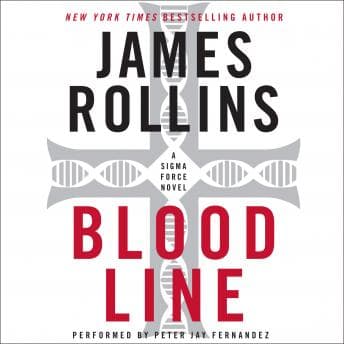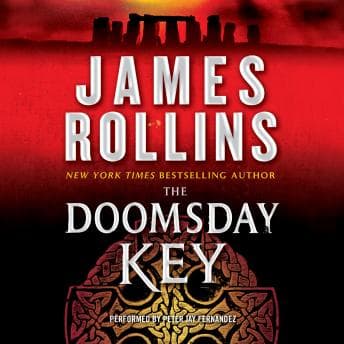
"Three murders on three continents, all marked by a Druidic pagan cross burned into their flesh."
I was reorganizing the occult section at the library—yes, we have one, yes, it's exactly as weird as you'd expect—when that line hit around the two-hour mark. Stopped me mid-shelve. Because here's the thing: James Rollins understands that horror isn't about gore. It's about dread. About the slow creep of something ancient and terrible bleeding into the modern world.
The Doomsday Key isn't horror in the traditional sense. It's a thriller wearing horror's skin, and honestly? That's scarier. Rollins takes real science—genetically modified crops, seed vaults, the terrifying fragility of global food systems—and wraps it in Celtic mythology, Vatican secrets, and a medieval codex that reads like a prophecy of extinction. My podcast listeners are going to eat this up.
When the Science Becomes the Monster
What Rollins does exceptionally well is make the threat feel inevitable. The book races from a biohazard lab at Princeton to the catacombs beneath St. Peter's Basilica to a Red Cross camp in Africa, and somehow it all connects. The pacing is relentless—14 hours and 29 minutes, and I never once considered hitting pause. That's rare for me. Usually by hour 8, I'm taking a break to pet Shirley and question my life choices.
The investigation at the Vatican particularly landed. There's something about ancient religious institutions hiding darker truths that just—works. Rollins isn't subtle about it, but he doesn't need to be. The motorcycle shoot-out that follows is pure adrenaline, the kind of action sequence that benefits enormously from audio format because you're not distracted by trying to visualize the choreography. You just feel it.
Fernandez: Committed (Mostly)
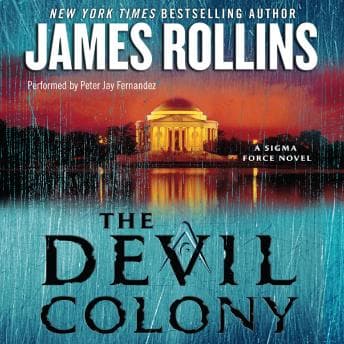
Peter Jay Fernandez has won an Audie Award, and you can hear why. The man commits. His gravelly Scottish brogue for certain characters creates immediate texture—you know exactly who's speaking before any dialogue tag lands. Fernandez brings that same lived-in quality to Devil Colony, another Sigma Force entry where his voice work does real heavy lifting across a sprawling cast. His Norwegian accent is... plausible. Which is more than most narrators attempt.
Here's where I'll be honest: the accent work is divisive. Some listeners find his foreign voices distracting, and I get it. There's a fine line between "distinctive character voice" and "wait, is that supposed to be Irish or Scottish?" Fernandez walks that line, occasionally stumbles, but never falls completely. His breathless style during action sequences genuinely raises tension—during the explosive confrontations in the final third, I caught myself holding my breath.
What he does brilliantly is handle Rollins's lengthy scientific explanations without making them feel like textbook readings. That's a skill. When you're explaining the mechanics of genetically modified pathogens for twenty minutes, you need a narrator who can make it sound urgent rather than academic. Fernandez delivers.
The Women Problem (Or: Rollins, We Need to Talk)
Okay. I have to address this. Gray Pierce is caught between his ex-lover and his new partner, and the book's own description promises he'll have to "sacrifice one of the women at his side." Look. I've read enough thrillers to know this trope. It's tired. Rollins executes it competently, but I found myself wishing for something more complicated than the love triangle dynamics we've seen a thousand times.
The horror elements—the mummified corpse in the English peat bog, the Druidic symbols, the "talisman buried by a dead saint"—those work. The interpersonal drama? Less so. It's the weakest thread in an otherwise tightly woven conspiracy.
Who Should Press Play (And Who Should Skip)
If you want atmospheric dread, this isn't it. If you want a conspiracy thriller that moves like a freight train and treats its science with genuine respect, you're in the right place. Fans of Dan Brown who wished he'd commit harder to the dark stuff will find a lot to love here. Horror purists might find it too action-forward.
I listened in the dark. Mistake? Maybe. Worth it? Absolutely. The final revelations about the Doomsday Key itself—I won't spoil it—genuinely unsettled me. Not because of what it is, but because of how plausible Rollins makes the threat feel.
One technical note: some listeners reported audio skipping near the end. My copy was fine, but worth checking if you encounter issues.
Closing the Book (But Not the Case File)
The Doomsday Key is a 14-hour commitment that earns every minute. Fernandez's performance elevates already propulsive material, even when his accents wobble. Rollins proves once again that he knows how to weaponize history—taking Celtic mythology and Vatican archives and modern genetic science and forging them into something genuinely threatening. That same formula—ancient evil dressed up in contemporary catastrophe—is what makes The Seventh Plague worth queuing up next if this one leaves you wanting more of Rollins doing what Rollins does.
Shirley (my cat) was unimpressed. I was hooked. That's usually how it goes with the good ones.