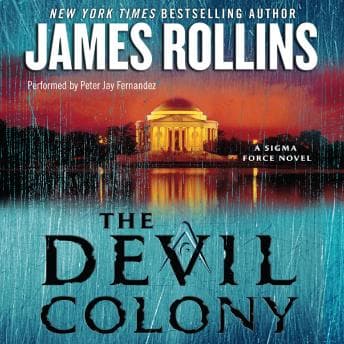

I was grading sophomore essays on The Great Gatsby at 11:47 PM—you know the ones, where every student discovers symbolism exists and suddenly green lights mean everything—when I needed something to keep me from writing increasingly sarcastic margin notes. Devil Colony turned out to be exactly the wrong book for that task. Not because it's bad. Because I kept stopping to Google whether any of this was real.
James Rollins does this thing that drives my inner English teacher absolutely crazy and my inner adventure reader absolutely wild. He takes actual history—the Mormon migration, Thomas Jefferson's fascination with Native American languages, the founding of the Smithsonian—and threads it into a conspiracy so elaborate you start questioning your own AP History curriculum. That same blend of historical intrigue and breakneck pacing shows up in Under the Magnolias, though with a completely different setting. Mummified bodies with gold plates? A secret cabal manipulating American history since the colonies? By hour three, I'd abandoned the essays entirely. (Sorry, third period. Your Gatsby papers waited until morning.)
When History Class Meets a Michael Bay Film
The premise is gloriously unhinged in the best way. Hundreds of mummified bodies discovered in the Rockies, gold plates with mysterious script, a teenage Native American activist on the run, and—oh yes—a geological meltdown threatening to turn the western United States into a very large crater. Rollins doesn't believe in small stakes. This is the literary equivalent of your uncle who starts telling you about his weekend trip and somehow ends up explaining how it connects to the Kennedy assassination.
But here's what separates Rollins from pure pulp: the man does his homework. The historical threads about the lost tribes, Jefferson's linguistic research, the actual mysteries surrounding early American exploration—these aren't invented from whole cloth. They're real puzzles he's connected with fictional wire. My students would call this "extra." I call it exactly my kind of obsessive.
Peter J. Fernandez Knows His Assignment
Fernandez narrates this like he understands the material. Which sounds like faint praise until you've suffered through action thrillers where the narrator treats every scene with the same breathless intensity until everything sounds like a car commercial. He modulates. The puzzle-solving sequences get a different energy than the chase scenes. Painter Crowe—Sigma Force's director and the emotional center here—sounds appropriately weighted by his position without becoming a monotone authority figure.
I can't point to a specific voice that made me sit up and take notice, and that's honestly fine. This isn't a character study. It's a freight train of plot that needs a conductor who won't derail it with theatrical choices. Fernandez keeps the momentum without sacrificing clarity. At fifteen and a half hours, that's no small feat.
The Rollins Formula (For Better and Worse)
If you've read Sigma Force before, you know what you're getting. Ancient mystery plus modern science plus shadowy organizations plus globe-trotting action. Iceland to Fort Knox to Yellowstone. The formula works because Rollins executes it with genuine craft—the pacing never sags, the science explanations don't read like Wikipedia dumps, and the action sequences have actual geography you can follow in your head.
But it is a formula. Some listeners felt this particular entry didn't land as hard as others in the series, and I can see why. The emotional stakes feel slightly diluted across too many characters. Painter Crowe's niece should be the heart of this story, but she gets lost in the conspiracy machinery. When you're juggling volcanic apocalypse, secret societies, and family drama, something's going to get shortchanged.
This reminds me of what Hemingway said about writing—you need to know what to leave out. Rollins sometimes struggles with that. He's so enthusiastic about his research, so eager to connect every historical thread, that the human moments get crowded out by plot mechanics.
Who's Going to Love This (And Who Should Read Middlemarch Instead)
If you want literary fiction, this isn't it. My students would hate this. I love it. But I love it the way I love a really well-made burger—satisfying, expertly constructed, not pretending to be something it's not.
Perfect for road trips. Long commutes. Any situation where you need your brain engaged enough to stay awake but not so engaged you miss your exit. The fifteen-hour runtime means you're committing to a relationship, but Rollins respects your time. No padding here.
Skip it if you need deep character work. Skip it if conspiracy thrillers make you roll your eyes. Skip it if you're looking for the best Sigma Force entry—longtime fans seem to rank this somewhere in the solid middle.
Class Dismissed
Devil Colony isn't going to change your life. It's not going to make you think differently about the human condition. But it will make you Google "Thomas Jefferson Indian languages" at midnight and fall down a Wikipedia rabbit hole for an hour. It will make grading papers feel slightly less like purgatory. And it will remind you that sometimes, reading—or listening—doesn't have to be homework.
The prose deserves to be savored at 1.0x, though I suspect most listeners will bump it up. Fernandez handles the acceleration well. Just don't blame me when you miss your stop because you needed to know what was on those gold plates.