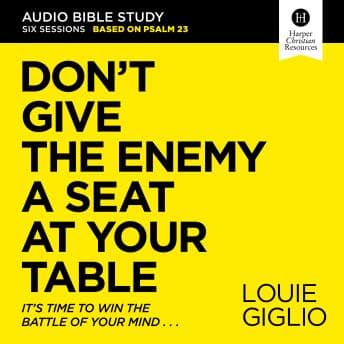

So here's the thing — a lot of people swear by Louie Giglio's approach to spiritual warfare and mental health. I'd seen this recommended in a few faith-based self-help threads and figured at 2 hours 15 minutes, the ROI calculation was simple. One evening of cooking dinner and cleaning up, and I'd be done. Which is exactly what happened. But whether that brevity is a feature or a bug depends entirely on what you're expecting.
Psalm 23 as a Mental Framework — Actually Not Bad
TL;DR: Worth your commute if you're already in the Giglio ecosystem. Conditional skip for everyone else.
The core premise is genuinely interesting, even from a secular lens. Giglio takes Psalm 23:5 — "You prepare a table before me in the presence of my enemies" — and builds an entire mental model around it. The "table" is your mind. The "enemy" is the loop of anxiety, doubt, and fear that hijacks your thinking. And the argument is: you get to choose who sits at that table. It's basically access control lists but for your thought life. (Yes, I just compared Scripture to network security. Kevin would be proud.)
The six sessions map out a progression from recognizing the problem ("The Table Before Us") through enemy tactics to the victory lap. And when Giglio locks in on the practical side — identifying destructive thought patterns, naming them, rejecting them — it actually lands. There's a reason cognitive behavioral therapy and biblical counseling overlap more than either side likes to admit. The "don't let the lie sit down and get comfortable" framing is sticky. I'll give him that.
The Overemphasis Problem Is Real
Here's where it gets rough. Giglio narrates this himself, and his delivery is... a lot. He's clearly a pastor who's used to working a room — big vocal swings, dramatic pauses, certain words PUNCHED so hard you can practically hear the stage lights flickering. "The ENEMY wants a SEAT at YOUR table." Over and over. The first session? Effective. By session four? I was chopping onions and genuinely couldn't tell if my eyes were watering from the shallots or from narrator fatigue.
I've seen listeners say they had to stop because the overemphasis made it physically tiring to listen to, and honestly — at 1.5x speed, which is my default — it made it worse. The dramatic pauses compressed into weird rhythmic jolts. I actually dropped to 1.25x, which is something I almost never do. That helped. But it shouldn't be necessary for a 2-hour listen.
His voice is clear, his diction is solid, and when he slips into genuine prayer at the end of sessions, there's a warmth there that works. But the sermon-stage energy doesn't always translate to someone's earbuds while they're scrubbing a cast iron pan at 9 PM.
The "Could've Been a Blog Post" Spectrum
At 2 hours 15 minutes, this is already lean. But it still feels padded. The central metaphor — table, enemy, seat, Psalm 23 — gets restated so many times across six sessions that by the midpoint you're thinking "yes, I got it, the enemy doesn't get a seat, we've established this." Strip away the repetition and you've got maybe 45 minutes of unique insight wrapped in sermon-style reinforcement.
And here's the kicker: this is designed as a companion to a study guide sold separately. So what you're actually getting is the lecture half of a two-part experience. Without the guide, without the reflection questions, you're getting the TED Talk without the workshop. That's fine if you know going in, but it means the standalone audiobook value is limited.
Who Gets a Seat at This Table
Perfect for: Anyone already doing small group Bible study who wants Giglio's teaching on the go. If you've read Goliath Must Fall and liked his style, this is the same energy applied to mental health and spiritual warfare. Also genuinely useful if you're in a season of anxiety and the faith-based framing speaks to you — the core message about not entertaining destructive thoughts has real practical legs.
Skip for: Anyone looking for a comprehensive standalone audiobook on mental wellness, even from a Christian perspective. The companion-piece structure means you're getting half the product. And if dramatic pastoral narration isn't your thing, the delivery will wear you down before session three.
The Debug Log
The underlying framework here is sound — pun intended. Identifying intrusive thoughts, refusing to engage them, redirecting to something grounded. That's good mental hygiene regardless of your theological stance. I landed in almost identical territory with Metahuman — completely different entry point, entirely secular, and somehow the same 'this could've been thirty minutes shorter' feeling by the halfway mark. But the execution as an audiobook is a 3-star experience: too repetitive, too dependent on external materials, and a narration style that works better from a pulpit than through earbuds. I finished it in one evening, I don't regret the time, but I won't be re-listening. The ROI on this audiobook is basically a solid sermon series you could've caught on YouTube for free.