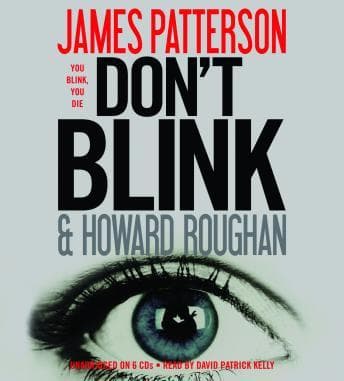

Everyone told me Patterson books are pure popcorn — the literary equivalent of a Michael Bay explosion sequence. And look, they're not wrong. But I went into Don't Blink expecting to be annoyed by sloppy character work, and instead I found myself genuinely curious about one thing: why does Nick Daniels keep pushing when every rational survival instinct says stop?
I was making chana masala on a Sunday afternoon — the kind of elaborate, unnecessary cooking project that takes three hours when you could just order delivery — and I needed something to keep my hands busy and my brain occupied. Seven hours felt manageable. A steak house murder, a reporter in over his head, mob connections. Sure. Let's go.
The McConaughey Problem (and Why It Stops Mattering)
So here's the thing nobody warned me about: David Patrick Kelly opens this audiobook with what I can only describe as a Matthew McConaughey audition tape. There's this almost-Southern lilt that made me check three times whether I'd downloaded the right book. Nick Daniels is a New York journalist, not a Texas rancher. Psychologically, this doesn't track — your brain is trying to build an image of this character while the voice is sending completely contradictory signals.
But — and this surprised me — Kelly finds his footing. By the time Nick is neck-deep in mob territory, the voice settles into something more controlled, more urgent. The funny asides land well, particularly during the chaos sequences after the Lombardo's murder. He's got this dry timing that works for a reporter character who processes trauma through humor. (My therapist would have thoughts about that coping mechanism, but it makes for good listening.) The transition isn't smooth, exactly, but it happens, and once it does, you stop noticing the narrator and start tracking the plot. Which, for a thriller audiobook, is basically the job.
Nick Daniels: A Case Study in Journalistic Death Wish
What makes this character compelling is that Patterson and Roughan actually give him a recognizable psychological profile. Nick isn't some fearless action hero. He's a reporter whose identity is so wrapped up in getting the story that self-preservation becomes secondary to professional compulsion. The protagonist exhibits classic approach-avoidance conflict — he knows the threats are real, he watches the violence escalate, and he keeps going anyway. Not because he's brave. Because stopping would mean he's not who he thinks he is.
The niece, Elizabeth, is where it gets interesting. Her bravery scenes give Nick something external to protect, which reframes his recklessness from selfish to — well, still reckless, but with emotional stakes that actually function. I found myself asking: why does Nick really stay in this? Is it the story? The girl? Or is he just someone who can't back down because backing down would collapse his entire self-concept? Patterson doesn't explore this with any real depth (this is still a Patterson book, not a character study), but the bones are there, and they're solid enough to keep you invested.
The name-dropping is real, though. There's a baseball interview setup that's swimming in celebrity references, and it occasionally reads like Patterson wanted to prove he knows famous people. It's the literary equivalent of someone casually mentioning they were at a party with Beyoncé. Distracting, a little eye-roll-inducing, but not fatal.
Seven Hours of Controlled Chaos
At seven hours, this is lean. Patterson's signature short chapters translate well to audio — each one punches, pivots, punches again. Kelly keeps the pace moving, and the steak house murder sequence early on is genuinely tense. You're sitting there with Nick at a nearby table, and the assassination happens with this clinical efficiency that the narration handles well. No over-dramatization, just the cold fact of it.
The research actually shows that thrillers with this kind of chapter structure — brief, cliffhanger-heavy — trigger a completion bias in listeners. You keep saying "one more chapter" because each one is four minutes long and ends mid-crisis. Patterson knows exactly what he's doing with pacing. It's manipulative in the best way.
Where it falters: the middle act gets talky. Nick's investigation involves a lot of conversations that blend together, and Kelly's character differentiation — while improved from the opening — doesn't always give each supporting player a distinct enough voice to track during rapid dialogue exchanges. I lost the thread a couple times while stirring my chana masala and had to rewind.
Who Gets the Most Out of This
If you want psychological complexity, this isn't it. If you want a fast, competent thriller that respects your time and doesn't ask you to suspend too much disbelief about human motivation — yes. Behind Closed Doors is where I'd point someone who wants that same propulsive, can't-put-it-down energy but with a psychological layer that actually goes somewhere. It works. Commuters, gym people, anyone who needs a plot that grabs you by the collar and doesn't let go for seven hours. Skip it if narrator voice quirks bother you early (you've been warned about the McConaughey phase) or if Patterson collaborations leave you cold compared to his solo work.
My Clinical Assessment
This is a fascinating case study in how formula, done competently, still works. Patterson and Roughan aren't reinventing anything here. But they understand one fundamental thing about human nature: we will follow a character into danger if we believe they'd follow themselves. Nick Daniels would. And so I did — standing over a pot of chickpeas, wooden spoon in hand, burning my cumin because I forgot to stir during the third act. Not a masterpiece. But it earned those seven hours.