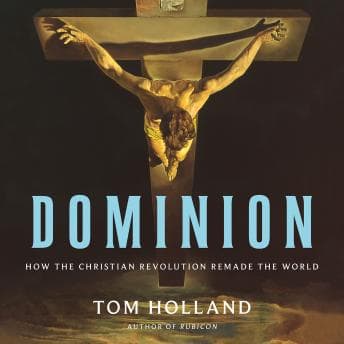

"Crucifixion, the Romans believed, was the worst fate imaginable, a punishment reserved for slaves."
That's how Holland sets up his entire argument, and by the time Mark Meadows delivers that opening salvo in his crisp Queen's English, you know you're in for something ambitious. I started this one on a late-night drive back from a client site in Houston - three hours of empty I-10, Ranger asleep in the back seat, and Tom Holland methodically dismantling everything I thought I knew about where Western values actually come from.
Let me cut to the chase: this is one of the most important history books I've listened to in years. It's also 22 hours long and demands your full attention. Not a casual listen. Not background noise. This is a sit-down-and-think kind of book.
The Thesis That Rewired My Brain
Holland's argument is deceptively simple: almost everything we consider "secular" or "universal" in Western civilization - human rights, the dignity of the individual, the idea that the powerful owe something to the weak - is actually Christian in origin. And not vaguely Christian. Specifically, traceable-to-particular-councils-and-theologians Christian.
He starts in ancient Babylon and Persia, moves through Greece and Rome, and by the time he reaches Paul of Tarsus you realize he's been setting up the intellectual equivalent of a controlled demolition. The Roman world had zero concept of universal human dignity. Crucifixion wasn't just punishment - it was a message about who mattered and who didn't. That a crucified Jewish peasant became the foundation of an entirely new moral framework? Holland makes you feel the absolute insanity of that transformation.
What got me was his treatment of the Enlightenment thinkers who thought they were throwing off Christianity. Holland traces how their supposedly secular ideas about equality and rights were soaked through with Christian assumptions they couldn't see. It's like watching someone insist they're swimming in fresh water while standing in the ocean. I've seen this scenario play out in real life - in the military, in consulting, people constantly operate on assumptions they've never examined. Holland just does it on a civilizational scale. Friedman tried something similar in World Is Flat 3.0, mapping invisible assumptions about globalization that most people swim in without noticing - though Holland operates at a depth Friedman never quite reaches.
The sweep is breathtaking. Babylon to the Beatles to #MeToo, and somehow it holds together. He connects Martin Luther to the Sexual Revolution. He draws a line from Gregory VII's papal revolution to modern concepts of international law. The author clearly did their homework - this is decades of scholarship compressed into a single narrative arc.
The Narration Problem Nobody Warned Me About
Here's where it gets complicated. Mark Meadows has a beautiful voice. Clear, dramatic, controlled. His Queen's English delivery gives the material a gravitas that feels appropriate for - well, for the entire sweep of Western civilization. When he's reading about Roman emperors or medieval popes, it works beautifully.
But around hour 8, I started noticing something. There are passages where Meadows seems to be performing the words rather than communicating them. Dense theological arguments about Pelagius or Marcion that need precise emphasis to land - and sometimes the emphasis falls in odd places, like he's reading the sentence for the first time. It's not constant, but when you're deep in Holland's argument about how Augustine's concept of original sin reshaped Western sexuality, you need the narrator tracking the logic with you, not just delivering pretty sounds.
Tom Holland himself narrates the introduction and conclusion, and honestly? His slightly less polished delivery actually works better for his own material. There's an urgency to it, a sense that he's genuinely wrestling with these ideas. When Meadows takes over, some of that urgency gets smoothed away.
I listened at 1.25x as usual, and for once I'd actually recommend dropping to 1.0x for the denser theological chapters. The ideas are too interconnected to rush.
Who Needs to Hear This (And Who'll Bounce Off It)
If you're the type who reads serious history and actually enjoys having your assumptions challenged, this is essential. Military folks, policy people, anyone who works in international contexts where you need to understand why the West thinks differently from other civilizations - the debrief here is invaluable.
If you want a straight chronological history of Christianity, this isn't it. Holland jumps centuries between chapters. Each chapter takes a specific year and location as a lens - it's more like 30 focused essays than a continuous narrative. That structure is brilliant on paper but can be disorienting in audio, especially during a long highway stretch when your attention dips for five minutes and suddenly you've jumped from 6th century Ireland to the French Revolution.
And if Meadows' very British delivery is going to irritate you for 22 hours - know that going in. Some American listeners bounce hard off it. I didn't mind it, but I spent enough time working with British officers that Queen's English just sounds like Tuesday to me.
Mission Debrief
Worth your time? Absolutely - with caveats. This is a 22-hour intellectual workout that will fundamentally change how you see Western civilization, secular values, and the invisible assumptions baked into every political argument you've ever had. The narration is good but not great, and the structure demands focus. I finished it at 2 AM in my driveway, engine off, staring at the garage door while Holland (reading his own conclusion) explained why even atheism is a Christian heresy. That one sat with me for days.
Ranger slept through most of it. Can't blame him - there aren't any explosions. But Linda would be surprised to know I found this more gripping than most thrillers. Mission accomplished, Mr. Holland. Mostly.