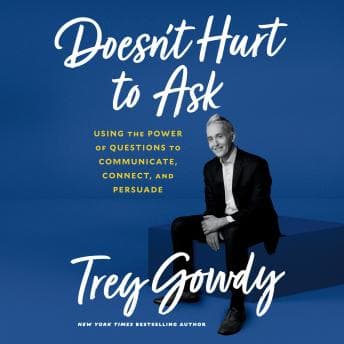

Trey Gowdy wrote a book about the power of questions, and the most important question is: does it actually deliver? Short answer - mostly yes, with caveats.
I was prepping for a client workshop on stakeholder communication when I queued this up. Late night, kitchen table, laptop open with slide decks I wasn't touching because Gowdy kept pulling me in with courtroom war stories. The man knows how to hold a room - or in this case, my AirPods.
A Prosecutor Who Actually Practiced What He Preaches
Here's what separates this from 90% of the persuasion books cluttering my Audible library: Gowdy isn't theorizing. He's recounting what happened when he botched his first murder trial by asking the wrong questions. He walks through the specific moment he realized his line of questioning was leading the jury away from his conclusion, not toward it. That's not a hypothetical from a B-school case study. That's a guy who almost lost a murder case because he got cute with his approach.
The framework is straightforward - know your objective before you open your mouth, understand who you're actually trying to persuade (your "jury"), and use questions instead of statements to move people. This is what my parents did instinctively. Now it has a TED talk. My mom never read a persuasion book in her life, but she could talk a supplier into better pricing on hangers by asking exactly the right questions about their inventory situation. Gowdy would call that "identifying leverage through inquiry." Mom called it Tuesday.
But here's where the book earns its keep - the sections on questioning James Comey and Hillary Clinton aren't just political theater rehashed. Gowdy breaks down his questioning strategy in those hearings, explaining why he chose specific sequences of questions to box witnesses into positions where their own answers did the persuading. That's genuinely useful technique, whether you're in a congressional hearing or trying to get your CFO to approve a budget increase.
The 45-Minute Problem (It's Real, But Less Severe Than Usual)
At 8 hours 52 minutes, this book is longer than it needs to be. But - and I'm surprised I'm saying this - it's less padded than most. Gowdy cycles between principle, courtroom anecdote, and political example with enough variety to keep the listen moving. The criminal justice reform chapter where a single conversation changed his position? That's legitimately interesting, because you hear a former prosecutor admit he was wrong, explain why, and show how the right questions from someone else shifted his thinking. Most politicians would rather eat glass than admit that. The willingness to sit with that kind of uncomfortable self-examination reminded me, oddly, of Book of Enoch the Prophet — a text where the entire moral architecture hinges on figures reckoning honestly with what they got wrong.
Where it drags: the sections on everyday application feel thin compared to the high-stakes examples. When Gowdy pivots from cross-examining witnesses to convincing your kid to do homework, the energy drops. It's not bad advice, it's just obvious advice dressed up in a suit. You don't need a former congressman to tell you to ask your teenager "what grade do you want?" instead of "do your homework."
I've seen the questioning technique he describes work at three different companies I've consulted for. Leaders who ask instead of tell get better buy-in. That's real. But the book could've made that point in half the time it spends on it.
Gowdy Reading Gowdy - It Works Better Than You'd Think
He's not a professional narrator and it shows in spots - the pacing is uneven, and he occasionally sounds like he's reading rather than telling. But when he hits the courtroom material, something clicks. The man has spent decades speaking to juries, and you can feel that muscle memory kick in. His closing statement passages have a rhythm and conviction that a hired voice actor wouldn't have nailed. There's a reason someone said they could listen to an entire book of just his closing arguments. I get it.
No sound effects, no music, no production tricks. Just a guy talking. For this kind of book, that's the right call.
Who Gets ROI From This
If you're in sales, consulting, management, law, or any role where you need to persuade people who don't report to you - this is worth your time. The questioning frameworks are practical and immediately applicable. If you're looking for deep communication theory or academic rigor, look elsewhere. This is a practitioner's playbook, not a textbook.
Skip it if you can't separate the messenger from the message. Gowdy is a polarizing political figure. If that's going to prevent you from hearing the actual content, save yourself the frustration.
The Key Takeaway Is Worth the Listen. The Other 7 Hours? Not So Much.
Bottom line: Gowdy's core insight - that questions are more persuasive than statements because they force the other person to reach your conclusion on their own - is worth the credit. The courtroom examples are the best part. The political examples are solid. The everyday life applications are filler. Listen at 1.5x (even I dialed it back from 2.0x because the courtroom pacing benefits from a slightly slower speed), and you'll get genuine value out of this. Jenny would say I'm being harsh. Jenny is right. But I'm also right that this book delivers where it counts.