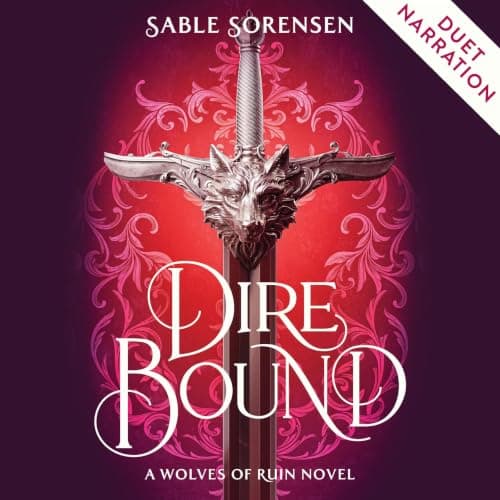

Five thousand-some listeners say this book left them wrecked, obsessed, spiraling. I finished it on snowshoes, halfway up a drainage I check every few weeks in winter, standing over a line of fresh wolf tracks. My first feeling wasn't spiraling. It was a quiet, stubborn wish that the wolves in my ears had been half as interesting as the ones that had just walked through here ahead of me.
That's not a takedown. Dire Bound is a competent, propulsive romantasy and I understand why people love it. But I came for the wolves. And the wolves, mostly, are there to carry the romance on their backs. Literally.
A wolf who refuses to talk is the best idea in this book
The setup's clean. Meryn Cooper, poor and resentful of the Bonded elite, enlists after her little sister Saela is taken across the border by immortal monsters (vampires, basically). That throws her into the Bonding Trials: four months at a castle, a cold instructor named Stark Therion who punishes weakness, a crown prince whose attention paints a target on her, and classmates who'd happily see her bleed.
What caught me was the direwolf. Meryn gets bound to a feral one who won't communicate. That's the most honest animal idea in the book, because a wild predator shouldn't want to open its mind to a stranger on day one. Trust with a canid is earned in small, boring increments. Distance. Patience. Not looking straight at it. I wanted the whole runtime to lean into that standoff.
It doesn't, really. The castle gets the attention. The rivalries, the instructor, the prince, the whispered secrets in the halls - that's where the story lives, and if you're here for enemies-to-lovers with a slow burn and some one-bed tension, you'll be well fed. I just kept glancing past the stone walls toward the tree line.
Dire wolves were real, and they weren't monsters
Okay, the field-ecologist part. I can't help it.
Dire wolves walked this continent until roughly thirteen thousand years ago. They were heavier than gray wolves but nowhere near rideable - a hundred-and-some pounds of animal can't carry a grown human at a run without wrecking its spine. Fantasy gets a pass on size; dragons get one too. Fine.
What I give less of a pass on is the framing. The book's own pitch calls these animals "massive" and "vicious," and that's the old, lazy lens on wolves. Real wolves avoid people. Their violence is mostly about territory and food, rarely about us. Here in Montana the state's been loosening the rules on killing them, and every story that teaches readers a wolf is a snarling weapon first makes that a little easier to stomach. (Yes, I know it's a romantasy. I still walked the rest of that ridge grumpy about it.)
To be fair, the bond is a mental link, a partnership, and the feral-wolf thread gestures at real wildness. It's not hostile to animals. It's just more interested in what a wolf can do for a person than in what a wolf actually is. High Divide is closer to what I wanted out there on the snow: a story where the country itself does the pushing back.
Two voices, and one kept disappearing into the wind
The duet narration is where listeners split, and my experience lined up with both camps.
Avery Caris carries the heavy load, and her range across characters is genuinely good - pitch shifts that let you track a crowded training yard without losing who's sneering at whom. Gabriel Michael has the kind of low, warm voice people write gushing reviews about, and yeah, I get it.
But. Several other listeners flagged volume and pace swings - stretches that drop too soft to follow, then climb louder and quicker. I hit that too, and outdoors it's a real problem. With wind coming down the drainage and the crunch of my bindings, some quieter passages just vanished, and I had to stop on a switchback and rewind. In a cabin at night it's manageable. Out on the land it cost me threads. A couple of listeners also said the cadence felt flat in places; I'd call it uneven more than flat. I'd happily hear Avery Caris again in Eight Seconds to Fly, where she's one of four voices, preferably with the windows shut and no drainage wind to fight.
I'll also echo something I saw in a few lukewarm reviews: Meryn's attitude doesn't always match who the book tells you she is. She's pitched as grounded and desperate, then she'll mouth off in moments where survival instinct should've shut her up. Some of the turns are predictable if you've read Fourth Wing. The sister-rescue drive keeps it honest, though - that's a real motivation, and it pulls through the twentieth hour.
Worth noting: Sable Sorensen is a pen name for two writers, Eliza and Annie, and this is book one of The Wolves of Ruin. It's a setup book and it knows it. At 21h 54m, that's a lot of setup.
Who should strap in, and who should stay off the trail
If you want an academy-trials romantasy with a brooding instructor, a charming prince, banter, and a feral bond that slowly thaws, you'll get your 22 hours' worth. If you came for wolves that behave like wolves, or you listen somewhere noisy, you'll be frustrated.
Tracks I'll follow, but not at full price
I'm curious enough about that silent wolf to see if book two lets it finally speak on its own terms. I'd grab this one on sale and listen indoors, volume up, woodstove going. Leave the wind out of it.