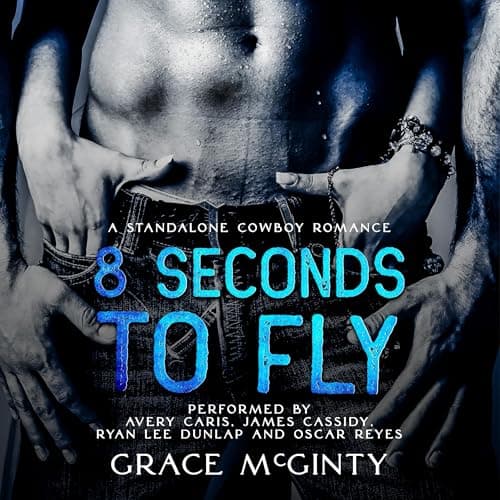
I wasn't expecting to be listening to a bull riding romance while splitting firewood in late October, but here we are. The first snow hadn't hit yet and I had maybe two more days of decent weather to get the woodpile stacked before I lost cell service for the season. I figured I'd queue up something light. Something that wouldn't demand the kind of attention I give to, say, a climate science text or a field ecology deep-dive. Eight Seconds to Fly caught me off guard.
Here's the thing — I went in skeptical. Rodeo fiction has a long, ugly history of romanticizing a world without understanding its actual texture. The dirt. The injuries. The same romanticizing problem plagues a lot of genre fiction — I ran into it even in American Religious History, where the subject matter deserved more grit than the framing was willing to give it. The way arena dust settles different than trail dust. And yeah, there are moments in this book where I could feel the author reaching for spectacle over substance. But Grace McGinty does something I didn't expect: she treats the rodeo world like a real ecosystem, complete with its own hierarchies, its brutal physics, and the way a woman moving through that space gets ground down by friction that has nothing to do with bulls.
Tessa May vs. the Boys Club That Runs on Inertia
Tessa May Everett is not a gentle protagonist. She's angry, she's grieving, and she's come back after four years to do something the circuit doesn't want her to do. The loss that drives her — her father, her place in the sport, her relationships with Branch and Beau — it's layered in a way that felt earned rather than manufactured. I appreciated that McGinty doesn't rush the grief. It sits in the story like silt in a creek bed. You feel it shift under every interaction.
The "eye roll moments" other listeners mention? Yeah, they're there. Some of the romantic banter skews a little too neat, a little too scripted for people who supposedly grew up covered in arena mud together. But I'll take imperfect dialogue over hollow emotion any day. And when the story hits — when Tessa May is facing down a rank bull and the crowd roar kicks in through the production — it hits like a sudden wind change on a ridgeline.
Four Narrators, One Arena
Four narrators for a nine-hour book is ambitious. Could've gone sideways fast. But Avery Caris, James Cassidy, Ryan Lee Dunlap, and Oscar Reyes each carve out distinct territory. Caris carries Tessa May's chapters with this raw, stubborn edge that never tips into melodrama. The male narrators — Cassidy and Dunlap handling Branch and Beau respectively, with Reyes rounding things out — create enough vocal separation that you're never confused about whose head you're in. That matters in a book juggling multiple love interests and rivalries.
The production itself deserves a nod. The crowd roar effects during ride sequences are scattered in just enough to create atmosphere without turning this into some overproduced audio drama. It's restrained. Smart. Like hearing a storm approach through the trees before you see it — you feel the energy shift before you process the sound.
Where the Fence Line Gets Wobbly
I need to be honest about the content warnings here. There's an attempted sexual assault scene, and the book carries violence and injury that goes beyond rodeo scrapes. McGinty doesn't shy away from the darker corners of this world, which I respect, but it means this isn't the lighthearted romp the "ride a few cowboys" tagline suggests. The tonal shifts between spicy romance and genuine trauma can feel jarring — like stepping from sunlight into a mine shaft.
And while the rodeo world is rendered with more care than I expected, there are moments where the sport feels like backdrop rather than living, breathing context. I wanted to smell the livestock, feel the chute gates rattle. Sometimes I got that. Other times, the arena faded behind the relationship dynamics. Not a dealbreaker, but noticeable if you're paying attention.
Who Should Listen (And Who Should Skip)
If you want romance with real physical stakes — a heroine who earns her bruises and a setting that doesn't feel like wallpaper — this one's worth your time. Skip it if you need your romances clean and uncomplicated; the content warnings are real, and the tonal shifts between heat and hurt aren't for everyone.
The Eight-Second Mark
I finished this one stacking the last row of lodgepole pine rounds, hands raw, sky going steel-gray. It's not a book about the wilderness I know, but it understands something fundamental about physical spaces that test you — that the arena, like the backcountry, doesn't care about your feelings. It just asks what you're willing to endure. Tessa May's answer to that question kept me listening past the point where I should've gone inside and started a fire. The romance runs hot, the grief runs deep, and the production makes the whole thing feel more present than a standard audiobook has any right to. Some rough edges, sure. But rough edges are how you know something's real.









